Adjacency Lodge
(Notes for a film)

First scene:
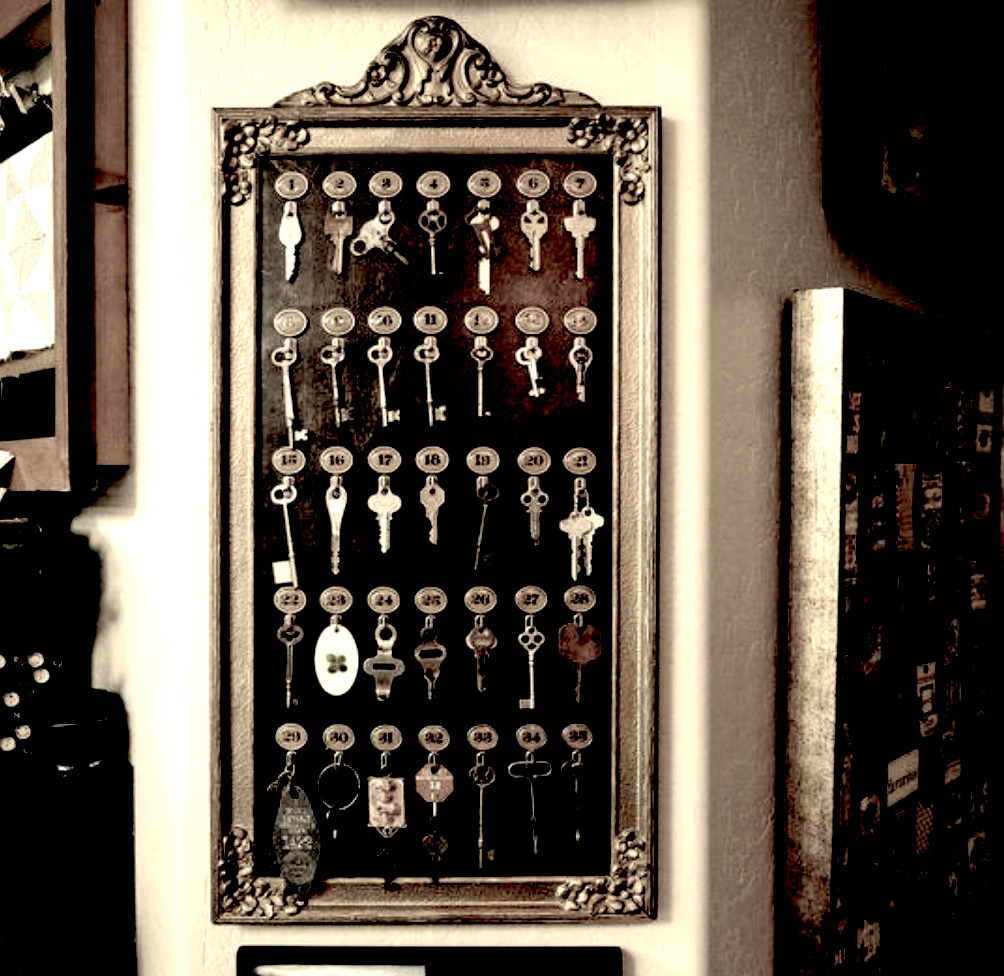
A wooden board behind the reception desk, framed in gilt, holds a grid of numbered hooks. From each hangs a key—no two alike. Some are long and slender, others blunt and worn, their teeth uneven from years of use. Small oval tags, each stamped with a number, rest above them in careful sequence.
Several hooks are empty.
A hand moves across the board, lifting a key, pausing, then placing it back on a neighboring hook, as if correcting an error that cannot be seen.
In the second scene we are in the apartment of the main character, Sandrine, a middle-aged accountant whose life has mostly been unremarkable. She unexpectedly receives notice of the death of her estranged father, an eccentric millionaire who stipulated in his will that in order to receive a generous inheritance she must live for a year at the Adjacency Lodge, a rustic but comfortable and reasonably upscale hotel located somewhere in the Catskills. All her needs and expenses will be met. Sandrine, who is at a time between jobs and has no alternate plan for the near future, is puzzled by the request but decides to take off to the Adjacency Lodge.
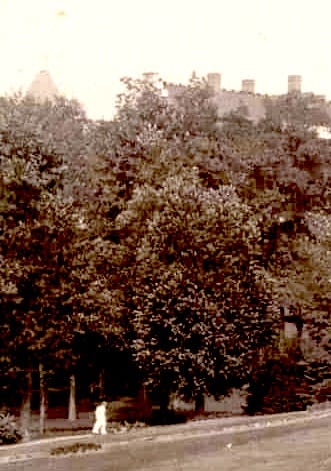
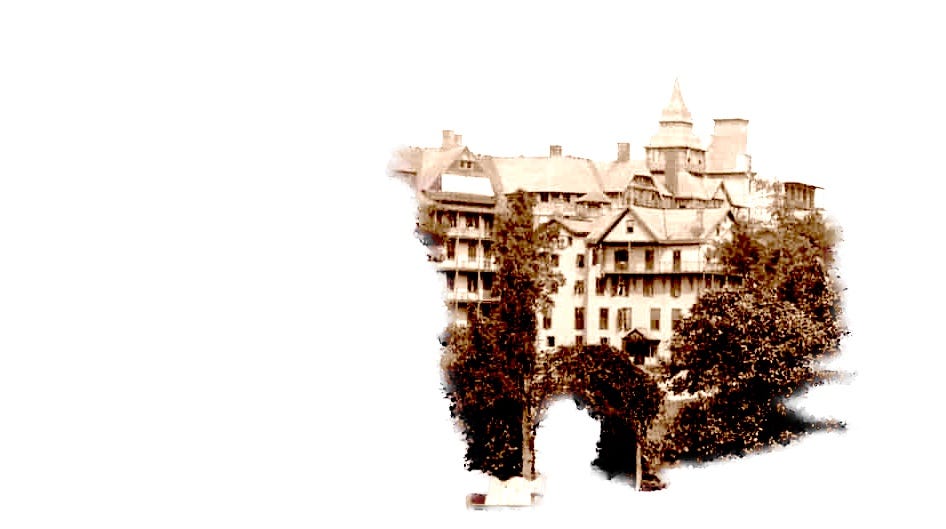
The building is a towering Victorian structure nestled in a lush forest, overlooking a large pond. Along its southern wing, a section appears to be under construction: scaffolding rises against the façade, and, in the distance, a small crew works steadily, their movements barely audible from where Sandrine stands.
At the Lodge she learns that the hotel has been there since 1881, and operating almost exactly in the same way since that time. Several old photos in the lobby attest to that fact. The furnishings, carpets and spaces of the hotel look identical to the ones shown in photographs from the era of its inauguration. It is unclear to Sandrine whether the furnishings have been updated, replicated or replaced, but at any rate they all look in excellent condition.
The receptionist is named Isidore. He has the peculiarity to speak with an uptalk speech pattern, wherein it would appear that every phrase ends with a question mark, thus making Sandrine slightly confused.
Sandrine asks about the construction.
“When are they going to finish the renovations?”
Isidore answers:
“We are always doing renovations. The hotel’s policy is to never finish building?”
Isidore points at one of the old photographs in the lobby, which, due to the attires of some people in it, appears to date to the early 1900s. In it, one can appreciate that the southern wing is under constructions
The lodge is far away from the town and Sandrine does not have a car, which makes it difficult for her to go away much. She asks Isidore whether there is anything walking distance.
“There is an extraterrestrial museum,” a man behind her answers. “I have never been but our guests seem to like it.”
The man behind has the air of an academic. He introduces himself: Maximilian Schmeltz, an ophthalmologist. They both head to the elevator.
“What brings you here?”, Sandrine asks.
“Like most of us, I am here for the long haul”.
Sandrine is confused about the answer, wondering if it is a joke, but doesn’t inquire further.
In the elevator, Sandrine realizes that the number 9 button is missing in the elevator keyboard. “That’s weird”, she says.
“Oh yes”, Maximilian answers. “This is because those of us who get invited to stay here have enneaphobia. You surely are one of them.”
Sandrine had never revealed this to anyone, so the comment made her very uncomfortable. “How did you know?” she asks. And, “what do you mean, you get invited?”
But at that moment the elevator opens in Schmelz’s floor where there is an acquaintance of his. He steps out as he greets his friend.
The resort has a movie theater, but with certain peculiarities: the films never show the ending, nor the critical moments where emotions are resolved. What is favored in the program are (partial) films by Hitchcock, David Lynch, and Bong Joon Ho. Sandrine also discovers an alternate, small, darkened screening room, this one showing only porn films, but also exclusively showing scenes of foreplay.
More annoying to Sandrine is the hotel’s restaurant, which serves very good dishes but has a policy by which the plate must be taken away from the guest before one finishes eating.
The library of the lodge is delightful; it reminds Sandrine of her grandfather’s dusty and large library with old wooden bookshelves and leather-bound volumes. The warm sunlight falls onto the burgundy carpet of the large, quiet room. But the books are missing the key pages where normally the plot would resolve, where the killer would be unmasked, where the questions built throughout the narrative would be answered.
---
By this point, Sandrine is very annoyed and upset about all the peculiarities of the hotel. She ask Isidore for some explanation about what is going on in this peculiar establishment. Isidore does not have any answers, but reveals to her that her estranged father knew the hotel’s owner, Sigfried Kienholz, from their high school years in their youth. Mr. Kienholz, Isidore “asked”, only came on Wednesdays, with the objective to catch butterflies in the Yellow Rose Garden. He would religiously arrive at 11am and then would promptly leave before lunchtime. “You might want to talk to him?”, Isidore suggested.
Sandrine meets Mr. Kienholz who somehow explains that he and Sandrine’s father were very close friends and theorized on the psychology of anticipation and fulfillment.
In the next scene we see the reception desk’s clock marking the exact dates: Wednesday, shortly before eleven. The scene cuts to a beautiful garden with a rustic bench, surrounded by lush bushes.
Sandrine makes a point of arriving at the Yellow Rose Garden a few minutes before eleven.
The garden is located at some distance from the main building, beyond a gravel path that curved around a small lake whose surface reflected the sky with an almost excessive clarity. The roses were not yet in full bloom, though many buds appeared to be on the verge of opening. A discreet sign read: Please do not touch the flowers until instructed.
At precisely eleven, a man appears at the far end of the garden. He was dressed in a light-colored suit that seemed slightly out of season, and carried a net of the sort used for catching butterflies, though Sandrine could not immediately see any butterflies in the vicinity.
“Mr. Kienholz?” she asked.
He turns, as if mildly surprised to find someone there. He has round glasses, bow tie, and a white, old-fashioned mustache that reminded Sandrine of a long-deceased grand uncle.
“Yes,” he said. “You must be Sandrine.”
There was something in the way he said her name that suggested recognition without familiarity, as though he had rehearsed the fact of her existence.
“I was told you might be able to explain… certain things about this place.”
Kienholz nodded, though not in agreement, more as if acknowledging the inevitability of her question. He motioned for her to walk with him along the perimeter of the garden.
“You’ve noticed the arrangements,” he said.
“Yes,” Sandrine replied. “The films without endings. The meals that are never finished. The books that stop just before—” She paused, unsure how to complete the sentence. “Before anything happens.”
Kienholz smiled faintly.
“On the contrary,” he said, “everything happens.”
They walked in silence for a few moments. A breeze passed through the rose bushes, causing several of the unopened buds to tremble slightly, as if considering the possibility of blooming.
“Your father,” Kienholz continued, “was very interested in a particular question. We both were, at the time. We wondered whether the culmination of an experience was in fact its weakest component.”
Sandrine frowned.
“That doesn’t make sense,” she said. “The whole point of something is for it to happen.”
“Is it?” Kienholz asked, without turning to look at her. “Or is the point to approach it?”
He stopped suddenly and lifted his net with a certain delicacy, as if responding to a signal Sandrine could not perceive. The net descended in a slow arc, but when he lifted it again, it appeared to be empty.
“Did you catch anything?” Sandrine asked.
Kienholz peered into the net.
“Not yet,” he said. “But it was very close.”
They resumed walking.
“Your father believed,” Kienholz continued, “that anticipation possesses a peculiar density. It accumulates. It expands to fill the space available to it. Fulfillment, on the other hand, is punctual. It occupies a single point and then dissipates.”
Sandrine thought of the meals in the dining room, of the fork suspended in midair just before the plate was taken away.
“That sounds like a justification,” she said, “for not finishing things.”
Kienholz laughed quietly.
“Perhaps. Or perhaps finishing is what diminishes them.”
They arrived at a bench at the far end of the garden. From there, one could see the lake again, though now partially obscured by a row of trees. The view seemed almost complete.
“We experimented,” Kienholz said. “In small ways at first. We noticed that a story withheld at the right moment remained far longer in the mind than one that concluded properly. A meal interrupted could be recalled in perfect detail, whereas a finished one quickly dissolved into general satisfaction. There is a great satisfaction in seeking completion, but that satisfaction is misleading because completion in it of itself always comes at the cost of the unrealized possibility of other scenarios.”
Sandrine was going to ask something, but Kienholz continued:
“Even fear—especially fear—was most potent before it found its object.”
Sandrine felt a slight unease.
At that moment, a gorgeous butterfly, with red and green colors in it. “Oh! It is a Mexican Silverspot”. He then made a curious choreographic gesture of attempting to capture it, but then letting it go. He seemed to focus more on his capturing movement than in the butterfly, which later flew away. He smiled.
“And this hotel is… what? An experiment?”, Sandrine said.
Kienholz considered this.
“It is a place,” he said, “where those observations have been given a certain consistency.”
“That’s not an answer.”
“No,” he agreed, smiling. “It rarely is.”
A bell sounded faintly in the distance—perhaps from the main building, though it was difficult to tell. Kienholz checked his watch.
“I must be going,” he said.
“But I still don’t understand,” Sandrine insisted. “Why am I here? Why did my father send me to a place where nothing is allowed to—”
She stopped herself again, unable to find the right word.
Kienholz folded his net with careful precision.
“Your father,” he said, “felt that you had a very strong sense of completion.”
“My father knew very little about me”, Sandrine said.
“But you are an accountant”, Mr. Kienholz said. “That is your job. You need precision.”
Sandrine looked at him in puzzlement.
“Exactly,” Kienholz replied. “He worried that you might have mistaken completion for meaning.”
Sandrine did not respond.
Kienholz began to walk away, then paused.
“Do try the lake tomorrow morning,” he said. “It is most beautiful just before sunrise.”
“And after?” Sandrine asked.
Kienholz smiled, though this time there was something almost sympathetic in his expression.
“I wouldn’t know,” he said, and continued down the path.
The following day, the film shows Sandrine packing and leaving the hotel.
In the elevator, once again she encounters Mr. Schmelz. He looks at her bag.
“Leaving already?”
“This place is not for me”, Sandrine says.
They ride the elevator in silence. When they reach the lobby, he gestures goodbye, saying:
“Certainty has no windows.”
She decides that she will visit the extraterrestrial museum on her way out, mainly out of curiosity. It is a very small museum, haphazardly constructed. The director, who is also the ticket taker and the one who runs the gift shop, welcomes her. He is wearing a purple velvet jacket and a emerald green ascot, making him look like some Halloween character— somehow the attire appears to be designed to fit with the museum theme, but in reality his costume appears to be totally incongruous with it. She buys a ticket to see the exhibits. All of them are of supposed UFO sightings in the area, which according to the museum is the extraterrestrial sighting capital of the world. One of the exhibits is of shadow people, mysterious beings that exist in the forested areas of that region.
The room dedicated to the shadow people was located at the very end of the museum, behind a heavy curtain that did not entirely conceal the space beyond it. A small handwritten sign read: Exhibit temporarily incomplete.
Sandrine hesitated for a moment before entering.
Inside, the lighting was dim, though not enough to obscure the outlines of the displays. Along the walls were photographs of wooded paths, mostly taken at dusk. In each image, one could make out a vague, elongated form—something like a person, though without any discernible features. The accompanying captions were unusually tentative:
Possible figure observed near Birch Hollow?
Unconfirmed presence, 1998?
Witness unsure whether alone?
At the center of the room stood a glass case, though it appeared to contain nothing. A label beneath it read simply: Apparition (absent at time of documentation).
Sandrine moved slowly around the room. There was a faint humming sound, as if coming from an electrical source that could not be located. Now and then, she had the impression that something shifted just beyond the edge of her vision, though each time she turned to look, there was nothing there.
She stopped in front of a mirror mounted on one of the walls. It was slightly clouded, as if it had not been cleaned properly. For a moment, she did not recognize her own reflection. The light behind her seemed uneven, creating a second, darker outline that did not entirely coincide with her movements.
She raised her hand.
The reflection followed, though with a barely perceptible delay.
Sandrine lowered her hand and stepped back.
In that instant, something became clear to her—not as a thought, but as a kind of recognition that did not require explanation. She understood, with a certainty that surprised her, that she could not return to her previous occupation. The precision of numbers, the closure of accounts, the satisfaction of balance—all of it now seemed to belong to a world that had somehow receded from her.
It was not that she rejected it. It simply no longer presented itself as a possibility.
She remained standing in the room for some time, though she could not later say how long. The humming continued, steady and indifferent.
Eventually, she stepped back through the curtain.
The man at the entrance looked up from a small notebook.
“How was it?” he asked.
Sandrine considered the question.
“I’m not sure,” she said.
He nodded, as if this were the expected response.
“That tends to happen,” he replied.
Outside, the light had shifted. The afternoon seemed to be approaching its conclusion, though without any clear indication of when it had begun to fade. Sandrine stood for a moment in front of the museum, then turned toward the path leading back to the lodge.
She walked more quickly than before.
When she reached the main building, she went directly to the reception desk. Isidore was there, arranging a set of keys in a precise but apparently unnecessary order.
“I’d like to come back,” Sandrine said.
Isidore looked up.
“Come back?” he repeated.
“Yes. I left, but I would like to return to my room.”
Isidore regarded her with a mild expression of concern, though it was difficult to determine whether the concern was for her or for the situation.
“You did leave?” he said.
“Yes,” Sandrine replied. “But I’ve changed my mind.”
Isidore nodded slowly.
“Yes,” he said. “That can happen?”
Sandrine waited.
“I can continue my stay,” she added. “The year—I can still complete it.”
At this, Isidore’s expression shifted slightly, though not into anything that could be clearly identified.
“I’m afraid that won’t be possible?” he said.
“Why not?”
“Because you’ve already left?”
“That doesn’t make any sense,” Sandrine said. “I’m here now.”
Isidore adjusted one of the keys on the desk, aligning it more precisely with the others.
“Yes,” he said. “But not in the same way?”
Sandrine felt a sudden tightening in her chest.
“I don’t understand.”
Isidore continued adjusting the keys, seemingly distracted, looking down.
“You did the right thing by leaving?” he said. “It was never intended for you to remain the full year?”
“That’s not what the will said,” Sandrine insisted.
“No,” Isidore replied. “But intentions and statements don’t always coincide?”
Sandrine leaned forward.
“I need to go back,” she said. “I need my room. My things—”
“Your things are being taken care of?” Isidore said gently.
“That’s not the point.”
“No,” he agreed. “It rarely is?”
There was a pause.
“Please,” Sandrine said, her voice now unsteady. “I don’t have anywhere else to go.”
Isidore lifted his gaze for a moment.
“Once a guest leaves,” he said, “it is no longer possible to return?”
Sandrine stared at him.
“Why?”
Isidore hesitated, as if searching for a formulation that would not fully resolve the matter.
“Because the stay,” he said, “depends on not having concluded?”
Sandrine felt tears rising before she could stop them.
“I haven’t concluded anything,” she said. “I just went to the museum.”
Isidore nodded.
“Yes,” he said. “That was enough?”
For a moment, unexpectedly, Sandrine thought about her father.
She began to cry openly now, the sound of it echoing slightly in the high-ceilinged lobby.
“I don’t understand,” she repeated.
Isidore did not respond immediately.
After a moment, he gestured softly toward the large window behind her.
“You should go,” he said. “It’s getting late?”
Sandrine turned.
In the distance, beyond the lake and just at the edge of the tree line, she could make out a figure moving slowly across the landscape. She thought about the shadow people she had seen at the museum. The light was such that the details were difficult to distinguish, but she recognized the posture: slightly bent forward, attentive, as if following something just out of reach.
Mr. Kienholz.
He raised his net in a measured gesture, then lowered it again. A small flicker of color—perhaps a butterfly—passed briefly through the air before disappearing into the trees.
For a moment, it seemed as though Kienholz might turn and look toward the lodge.
He did not. He was talking to the ophthalmologist, Mr. Schmelz. They are pointing at something in the sky.
Sandrine is standing there, still crying, though more quietly now.
When she turns back, Isidore is already resuming his arrangement of the keys.
Jamesian. Poesque. Helgueristic.
It must take a lot of courage to share story ideas for a movie on the internet...!