Building Strange Oases
On Practices of Play

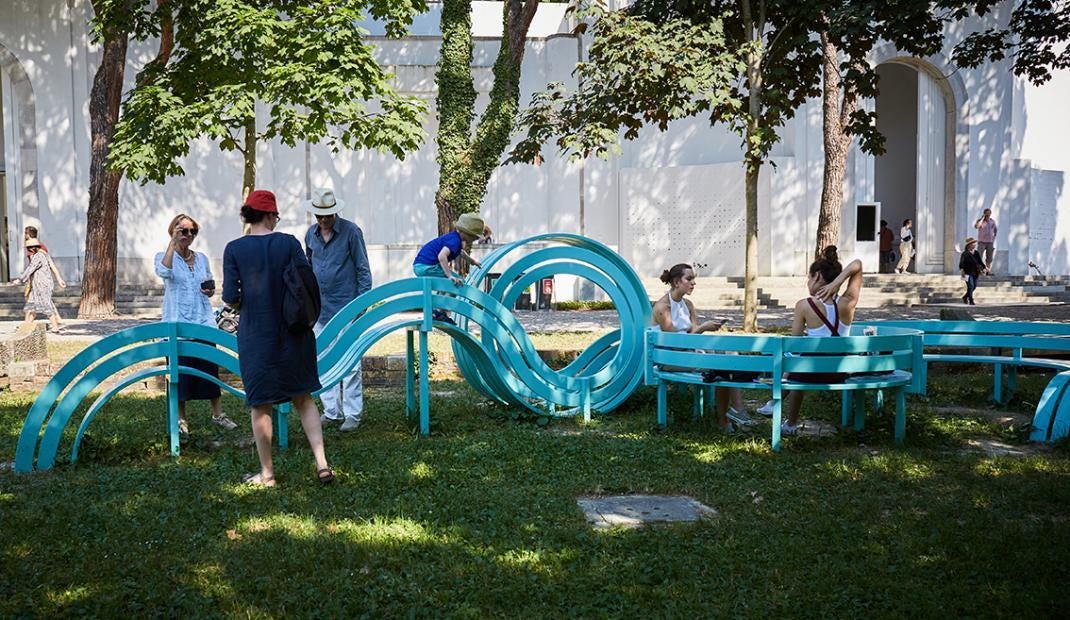
The following text is drawn from a lecture I gave this week at the Power Plant Gallery of Contemporary Art in Toronto, Ontario, as part of the exhibition Colourful Parachutes: Imagining Alternative Futures Through the Power of Play, curated by Frances Loeffler.
For Luis Ignacio Helguera Soiné (1926-2005)
In the poem Lisboa Revisitada (Lisbon Revisited), written in 1926, Fernando Pessoa, through one of his heteronyms, Álvaro de Campos, wrote:
I know very well that in everyone’s childhood there was a garden,
private or public, or belonging to a neighbor.
I know very well that play was its master.
And that sadness belongs to today.
I have been thinking about this passage for many years. Partly because it has a personal resonance for me: my father was born in 1926, the same year the poem was written, and his birthday this week, June 3rd, would have marked his one hundredth birthday.
But there is another reason I keep returning to these lines. In the Spanish version where I first read this poem as a teenager, the third line was translated into Spanish as “donde la única regla era jugar” (“where the only rule was to play”). That phrase stayed with me.
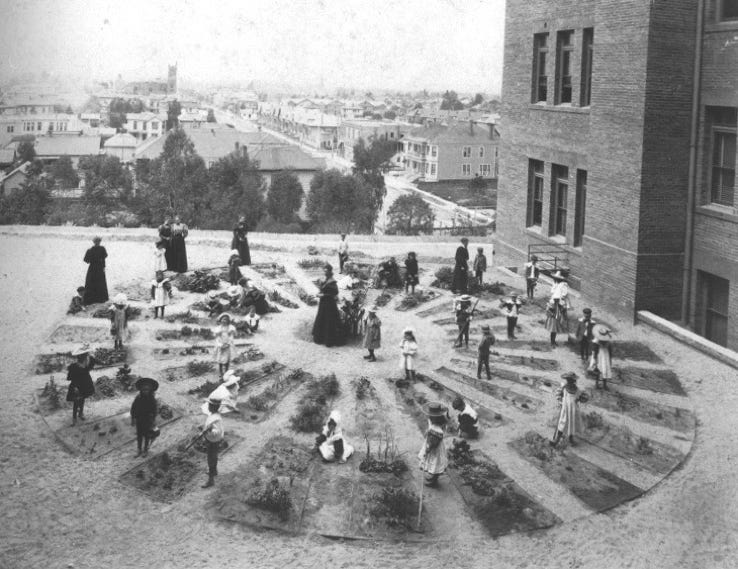
The compelling poetic idea of Pessoa’s garden is not just the idea that its ownership or location is not important, but that within its boundaries another set of rules applies: the governing principle of play.
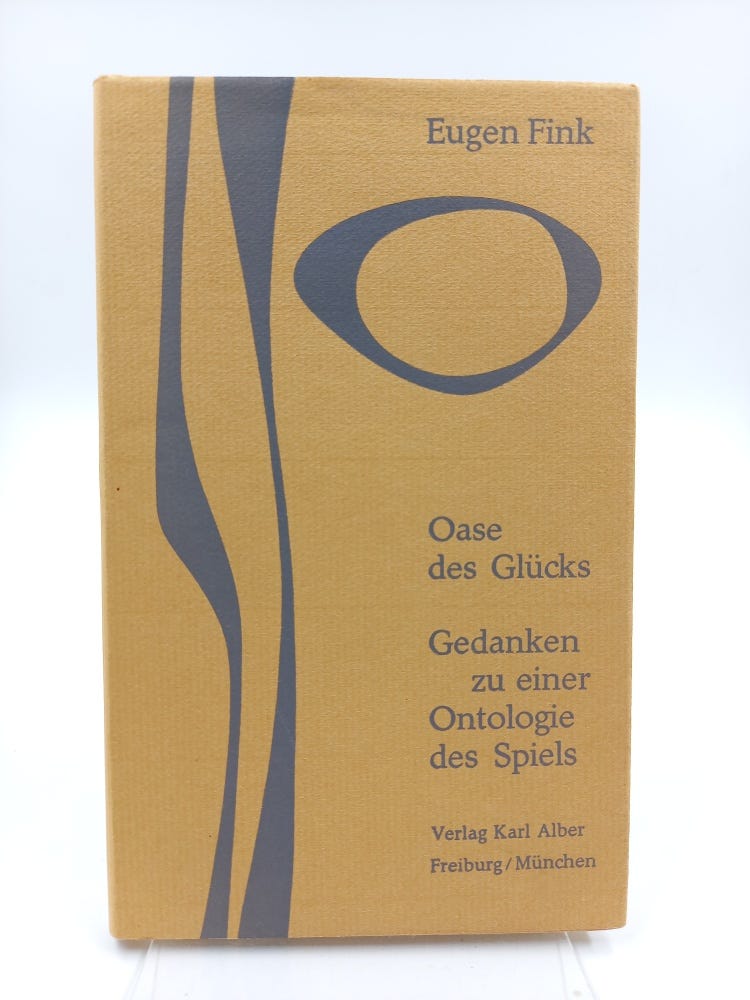
The image reminds me of a concept developed by the German philosopher Eugen Fink in his 1957 essay Oasis of Happiness ( the opening section of his book Play as Symbol of the World). Fink argues that, for adults, play appears as a “strange oasis” within the routines and obligations of everyday life. It is a temporary interruption of ordinary existence, a moment in which we step outside the structures that organize work, productivity, utility, and social convention.
I find myself imagining that Pessoa’s garden and Fink’s oasis are, in fact, the same place.
Both describe a bounded territory within ordinary life. Both are spaces in which alternative rules prevail. Both suggest that play is not merely entertainment but a distinct mode of experience—a way of encountering the world differently.
This idea serves as the point of departure for this essay. I would like to suggest that much artistic practice of the last half century—from participatory and socially engaged art to contemporary pedagogical projects—can be understood as the construction of such spaces: temporary oases in which different forms of attention, interaction, imagination, and social relations become possible.
In this sense, contemporary art can be understood not simply as the production of objects but as the creation of strange oases: provisional worlds where the usual rules are suspended and where other possibilities briefly come into view (in a past essay where I described Federico da Morais’ monthly educational programs at the Museo de arte moderno de Rio de Janeiro in 1971, Domingos da creaçao, I discussed how self-imposed restrictions are catalysts for creativity, or as Mariano Pedrosa put it, the experimental practice of freedom).
Adults often have a complicated relationship with play. While children rarely need to be convinced to play, adults, on the other hand, frequently approach playful situations with hesitation. We worry about looking foolish. We worry about doing something incorrectly. that we are being asked to participate in something frivolous or beneath us
Over time, I came to realize that this resistance is not necessarily a rejection of play itself. Rather, it reflects the values adulthood asks us to internalize. We are taught to value activities that produce measurable results. We are expected to be productive, efficient, and purposeful. As a consequence, activities whose outcomes are uncertain—or whose value cannot be immediately demonstrated—can feel uncomfortable or even vaguely irresponsible.
What I witnessed repeatedly in museums was that the challenge was rarely getting adults to understand an idea. The greater challenge was creating conditions in which they felt permitted to engage with uncertainty, experimentation, and imagination without fear of appearing ridiculous. In other words, the challenge was not teaching people to think. It was helping them rediscover how to play.
Play, of course, is never ruleless. Every game, every performance, every imaginative world depends on a set of constraints. What distinguishes play from ordinary life is not the absence of structure but the willingness with which we enter it.
Throughout my years in museum education, I often encountered situations in which institutions attempted to create playful experiences for adults but misunderstood this principle. Participants were asked to perform activities that felt arbitrary, infantilizing, or disconnected from their interests. While the intention was generous, the result was often the opposite. Entertainment, participation, and play cease to function when they are imposed. Being instructed to have fun can feel strangely joyless. Being required to act spontaneously can feel deeply artificial.
Many adults resist such situations not because they reject play but because they sense they are being asked to perform someone else’s idea of playfulness.
The challenge, then, is not simply to create opportunities for participation. It is to construct spaces that acknowledge the intelligence, anxieties, experiences, and agency of those who enter them. A successful oasis does not force people into play —rather, it incites them to partake.
Psychologists and educators have long noted that adults continue to engage in playful behaviors throughout their lives, even when they no longer describe them as such. Jerome Bruner argued that play is a mode of exploration in which we can experiment with possibilities while temporarily suspending the pressure of consequences. Play allows us to ask “what if?” before committing ourselves to a course of action.
If that is true, then much of adult life turns out to be more playful than we imagine. Scientists construct experiments. Writers invent scenarios. Architects sketch unrealized buildings. Musicians improvise. Entrepreneurs speculate about futures that do not yet exist. We engage in rehearsals, simulations, thought experiments, and hypotheticals. In each case, we enter a provisional space where ideas can be tested without immediately becoming reality.
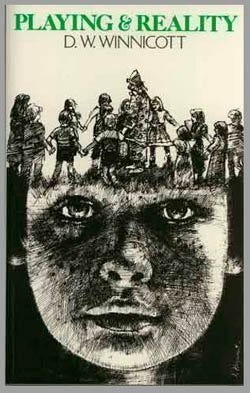
Donald Winnicott went even further. In Playing and Reality, he argued that creativity emerges from what he called a “potential space” between the inner world of imagination and the external world of facts. Adults continue to inhabit this space whenever they create, imagine, perform, tell stories, or engage with works of art. From this perspective, the oasis never disappears. It simply changes form.
Johan Huizenga, the Dutch historian and author of Homo Ludens, argues that adult playgrounds (social contexts with specific rules of engagement that must be fulfilled for them to function properly) exist all over our social world, ranging from the sports arena to the courthouse, up to and including the film screen and the theater stage.
Looking back on projects I have developed over the years—whether a temporary bookstore, a portable school, a storytelling spa, a memory theater, or a 1830s New Mexican casino—I increasingly realize that what interested me was never simply the activity itself. What interested me was the creation of a condition: a bounded social space in which people could temporarily operate according to different assumptions. The artwork functioned less as an object than as an invitation into a particular mode of attention.
What we often call creativity, innovation, research, or artistic practice may be understood as socially sanctioned forms of play. The adult does not stop playing; the adult learns to disguise play under other names.
This realization has important implications for participatory art. Too often, participatory projects assume that they must teach participants something entirely new. But perhaps the task is subtler. Perhaps the role of participatory art is not to introduce play into people’s lives but to reveal forms of play that are already present there.
In this sense, participatory art resembles the Platonic concept of anamnesis: the idea that learning is not the acquisition of new knowledge but the recollection of something we already possess. The teacher does not deposit knowledge into the student. Rather, the teacher creates the conditions through which the student recognizes something that was already latent within them.
The same may be true of participation. A successful participatory artwork does not force people into unfamiliar territory. It helps them become conscious of capacities they already exercise every day: imagining alternatives, inhabiting different perspectives, negotiating rules, collaborating with others, and navigating uncertainty. The artwork becomes a mirror in which participants encounter forms of knowledge they already possess but rarely have the opportunity to see.
I sometimes wonder whether the growing interest in participation, interactivity, social practice, and collaborative forms of art reflects a broader condition of contemporary life. We spend much of our time being evaluated, measured, categorized, and asked to justify our actions through tangible outcomes. Under such conditions, spaces in which exploration can occur without immediate consequence become increasingly rare.
What artists often create, consciously or unconsciously, are temporary refuges from these pressures. Not escapes from reality, but suspensions of some of reality’s demands. Spaces in which people can momentarily set aside the need to be correct, efficient, productive, or certain.
The most successful participatory works are rarely those that ask people to do something entirely unfamiliar. Rather, they offer recognizable frameworks—stores, libraries, classrooms, games, celebrations, performances, archives, playgrounds. We know how to inhabit these forms. The artist’s task is not to invent a world from nothing but to subtly reorganize a familiar one.
Play grants us permission. Permission to imagine alternatives. Permission to experiment without certainty. Permission to occupy different roles. Permission to ask “what if?” Permission, for a moment, to stop performing adulthood and to engage with the world through curiosity rather than obligation.
In this sense, the artistic oasis is not a place where we become children again. It is a place where we remember capacities that adulthood has taught us to conceal.
That, I believe, is the deepest promise of participatory art. Not that it teaches us something we did not know, but that it helps us recognize something we have known all along.
Perhaps that is why Pessoa’s garden continues to resonate. It was never simply a place from childhood. It was a reminder that somewhere within ordinary life there remains a territory governed by different rules. We enter it briefly, and then return. But for a moment, play is its master.
I was at this talk this past Monday in Toronto. Loved the opening on the garden of childhood. As complicated as our internal worlds become, it was a reminder that everyone was once a child, and that everyone has an inner world as deep and surprising as our own.
We grow up to become self-conscious, afraid to be seen playing in case we look foolish. But the return to play is probably where our most vital and easeful selves live. Huge respect for what you do and thanks for this beautiful reflection.
I love this. One thought I had, having tried to play in museums many times, is that the social context of play also matters. Playing alone in a neighbor’s garden reminds me of Winnicott’s “playing alone in the presence of the mother” and Bachelard’s “the house shelters dreaming” — spaces where you are simultaneously safe and unobserved, free to imagine, to attempt, to fail, to reimagine. Museums, for all their wonder, are highly regulated spaces, so maybe they add special difficulties for the creation of oases. I remember trying to play with a model of one of Lygia Clark’s bichos under the very watchful eye of a museum guard. I didn’t last long.