Fútbol

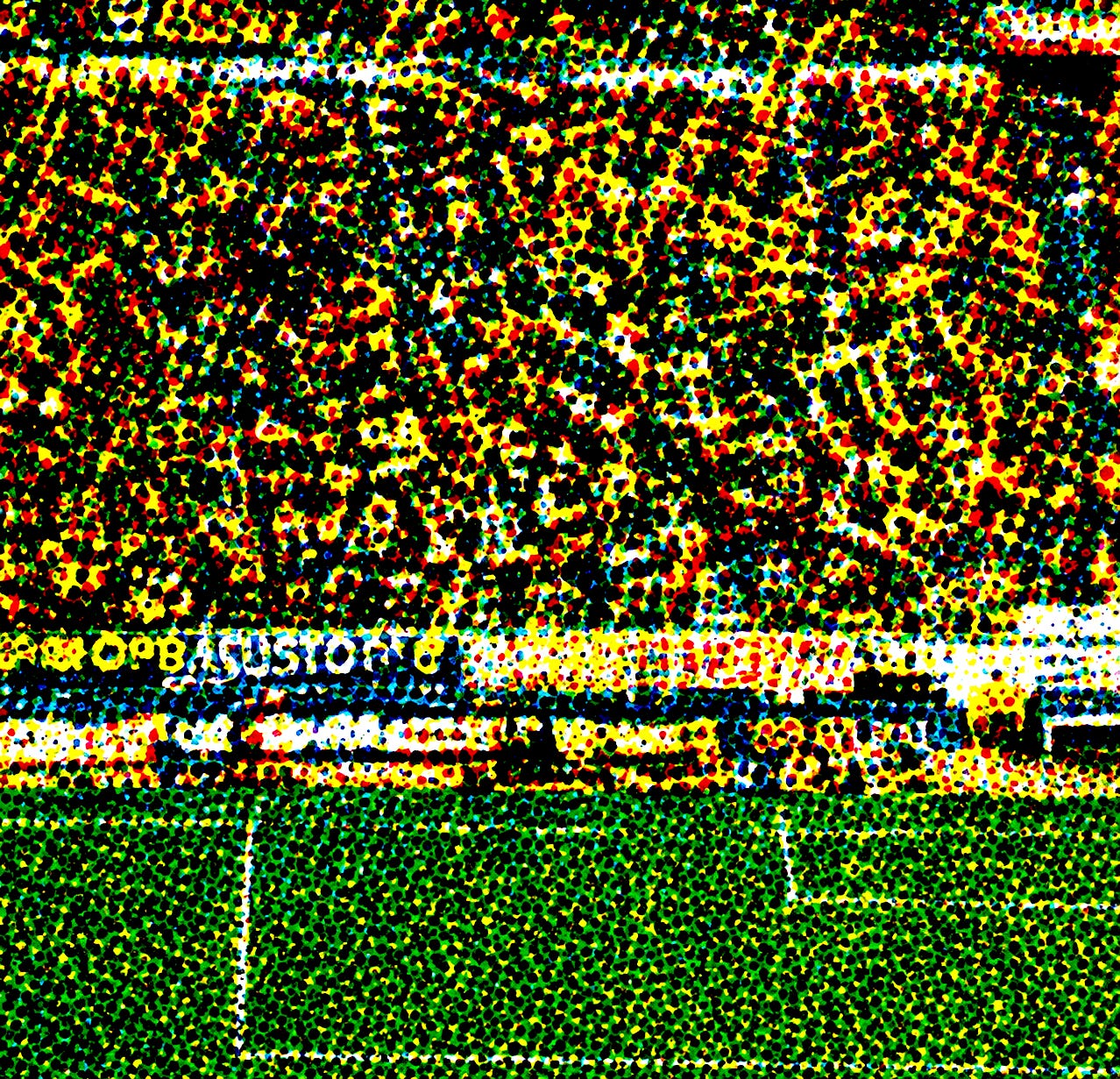
One of my earliest memories is watching the 1978 World Cup final with my family and seeing Argentina crowned champion. I was seven years old and understood little about tactics or competition, but I could sense the emotional voltage surrounding the event. The adults were animated, the room seemed charged with expectation, and the outcome somehow felt larger than a game. The World Cup is here again, bigger than ever, with three host countries for the first time. For many Americans, it remains a curiosity—a sporting event they know is important without fully understanding why. Yet every four years, billions of people around the world suspend ordinary life to watch twenty-two players chase a ball across a field.
What fascinates me about soccer is not merely the sport itself but the extraordinary symbolic weight it carries. If Roland Barthes had chosen to write about soccer instead of wrestling in Mythologies, he would have encountered a more elusive but perhaps richer subject. Wrestling, as Barthes observed, is a spectacle of signs whose meanings are immediately legible: heroes, villains, suffering, justice. Soccer is different. Its meaning emerges through uncertainty. A missed penalty, an injury, a referee’s decision, or an unexpected bounce of the ball can alter the destiny of a match in an instant. Entire nations invest themselves emotionally in these contingencies, transforming a game into a drama of collective identity, fate, and belonging.
I grew up surrounded by people for whom the game was a language. My brother Nacho was an avid fan who bought the weekly magazine Penalty! from the neighborhood newsstand and followed the Mexican league religiously. His loyalty belonged to Club León, and he remained devoted to the team even during the years it languished in the Segunda División. Like many supporters around the world, he treated allegiance less as a choice than as an inheritance.
We organized imaginary tournaments in our garden, narrating our own matches with all the seriousness of professionals. The 1986 World Cup in Mexico only intensified that fascination. I was fortunate enough to attend a match at the Estadio Azteca, one of the great cathedrals of world soccer. What I remember most is not the game itself but the atmosphere: the overwhelming scale of the stadium, the sea of colors, the chants, and the sense that thousands of strangers had temporarily become a single body. It was also a place where one learned that collective passion had its darker side. Spectators had to remain alert for flying objects, including the notorious “agua de riñón”—water bottles filled with urine hurled from the stands. Even so, the experience revealed how profoundly soccer could transform ordinary space into ritual space.
For those who have never experienced soccer culture firsthand, its scale can be difficult to comprehend. The World Cup routinely attracts audiences measured in billions rather than millions, and the world’s most recognized athletes are often soccer players rather than movie stars or musicians. The person with most Instagram followers in the world (660 million) is Cristiano Ronaldo, which is more than Beyonce and Taylor Swift’s followers combined. He is followed by Lionel Messi (505 million). Yet statistics alone do not explain the sport’s power. Soccer is much more than a game; it is a cultural phenomenon through which communities find identity, whether at the local or national level. We root for our own, and our emotional attachment to a city or country flourishes when they win and falters when they lose.
Eduardo Galeano captured this drama perfectly in “El futbol a sol y sombra”: “The fan can shake off the boredom of everyday life and put on the colors of his team. In the crowd, he escapes from loneliness. But when the referee blows the final whistle and the crowd disperses, the fan returns to being nobody: the we dissolves, and the I returns.”
More than tactics or statistics, what remains ingrained in me is soccer’s theatricality. The game is poetry, choreography, and drama all at once. I will never forget the legendary Mexican commentator Ángel Fernández, who embodied the declamatory power of the narrator. Like the coryphaeus in a Greek tragedy, he interpreted events for the audience, transforming athletic competition into epic narrative. Listening to him, one understood that soccer was not merely played; it was also performed.
A work that brilliantly captures both the drama of soccer and the investment of national identity in the game is Miguel Calderón’s 2004 video México vs Brasil, created for the São Paulo Biennial. Using archival footage from actual matches, Calderón constructs an impossible fantasy: a game in which Mexico scores against Brazil every five minutes, ultimately handing a devastating 17-0 defeat to what was then widely regarded as the strongest soccer nation in the world.


The work is simultaneously humorous and revealing. On one level, it dramatizes the emotional extremes that accompany victory and defeat—the humiliation of losing and the intoxicating affirmation of winning. On another, it exposes the wishful thinking that often underlies nationalist sentiment, imagining a triumph so improbable that it borders on the absurd. Yet the fantasy acquired an unexpected afterlife a decade later, when Germany defeated Brazil 7–1 in the 2014 World Cup semifinal in Belo Horizonte, Brazil’s own home, producing one of the most shocking and painful defeats in Brazilian soccer history. Calderón’s fictional rout suddenly seemed less like satire and more like a reminder that, in soccer, even the unthinkable can become reality.
I was never a particularly passionate follower of fútbol, although I was often drawn into the magnetic excitement of its communal rituals, usually through my brother, who once won a small prize through Pronósticos Deportivos, the state-sponsored sports betting game that enjoyed widespread popularity in Mexico during the 1980s. Watching the World Cup with family and friends gathered around a television set was not so different from the opera screenings my uncles would host using the newly introduced—and ultimately short-lived—laserdisc technology. Proud of their ability to access the latest productions from Covent Garden or La Scala, they would invite relatives and friends to gather around the television for what was as much a social occasion as a cultural event. In both cases, the screen provided a common point of attention, but it also allowed for a kind of social drifting: conversations branched into other topics, jokes circulated, stories were told, and the event became woven into the fabric of everyday interaction. What mattered was not only what happened on the field—or on the stage—but also what happened around it. Soccer, like opera, offered a pretext for gathering, a framework through which friendships, family bonds, and collective memories could be rehearsed and renewed. At times, these interactions seemed more significant than the spectacle itself.
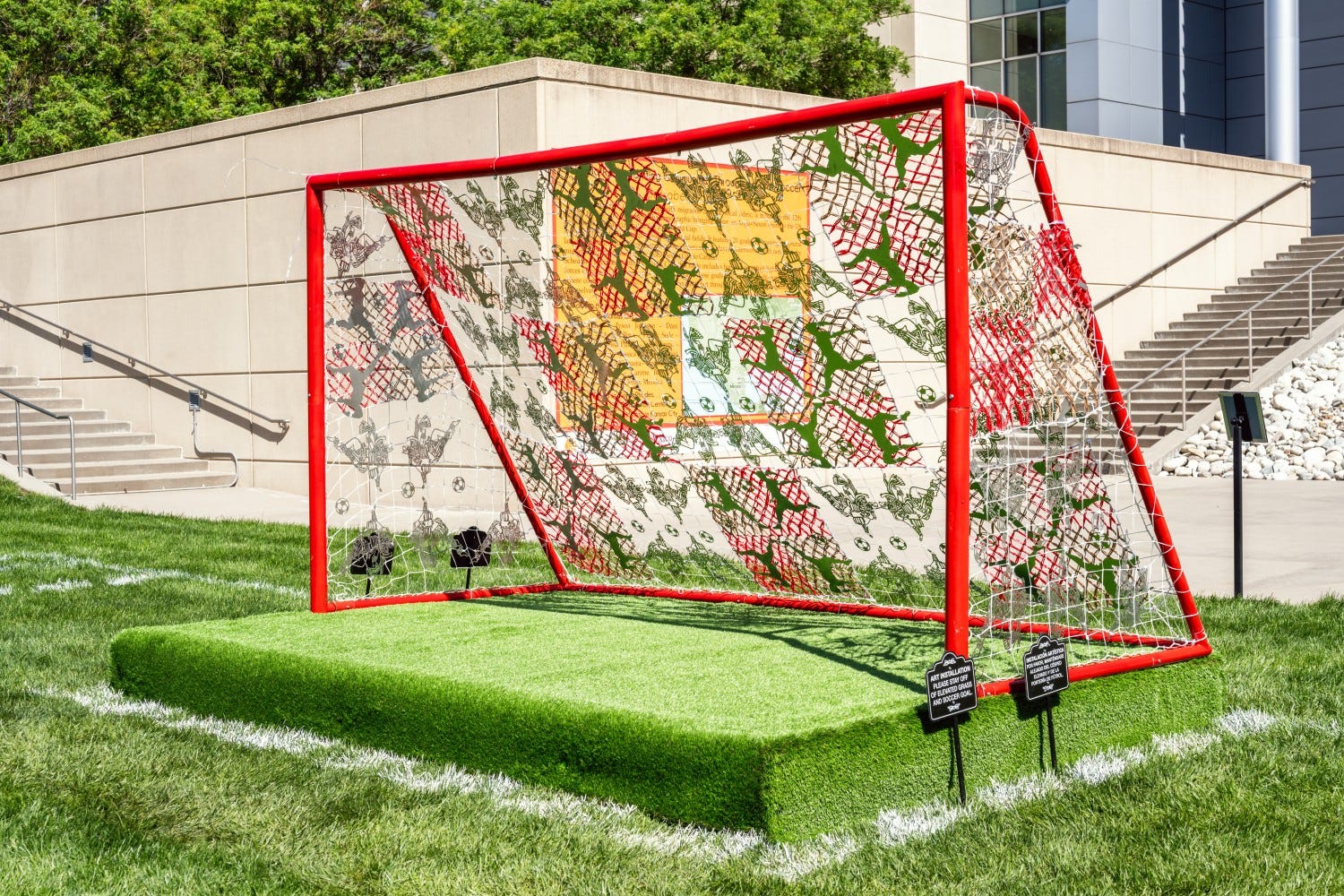
Some artists have noted that aspect of the sport. In Tejiendo Redes, Betsabeé Romero uses the soccer net as a metaphor for the invisible ties that bind communities together, suggesting that fútbol is less a game than a social fabric woven from shared identities, memories, and migrations.
Perhaps this is why soccer has proven so enduring across cultures and generations. It is not merely a sport but a ritualized suspension of ordinary life. For ninety minutes, work gives way to play, utility yields to symbolism, and individual concerns dissolve into collective experience. The stadium becomes a theater, a temple, and a public square at once. The players perform, but so do the spectators, who chant, lament, celebrate, and narrate the action as members of a vast chorus. What emerges is a rare space where the artistic and the sacred remain inseparable. Soccer constructs identity not through doctrine but through participation; not through belief alone but through repeated gestures, songs, colors, memories, and myths. Like all powerful rituals, it allows a community to imagine itself and, for a fleeting moment, to become visible to itself—whether in a stadium of eighty thousand people or around a television set in a family living room.
And now, I should be on my way. A few blocks from my apartment, the owner of my neighborhood Italian restaurant—an Argentine, naturally—has installed a screen where friends and regulars will gather to watch the opening match of the World Cup, Mexico versus South Africa.
Before joining them, however, I want to leave you with what has become one of the most celebrated poems about fútbol in the Spanish language. Its author, the late Antonio Deltoro (1947–2023), was a dear friend of both my brother and me. Toni had a remarkable gift for finding moments of revelation in everyday life, and nowhere is that gift more evident than in this poem. I offer it here in a provisional translation.
beautiful