

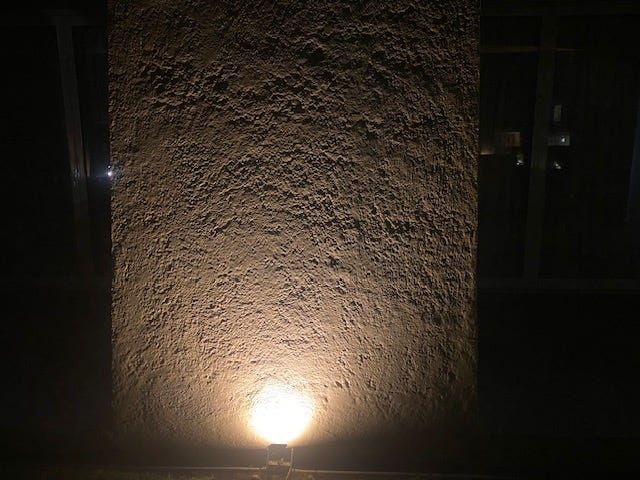
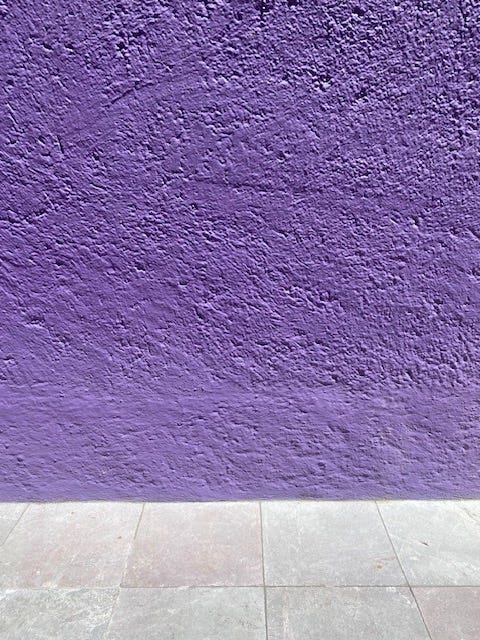
As I write these lines, one summer night in Mexico City, I am staring at a wall. It stands in a garden, illuminated from below. There is nothing remarkable about it: it belongs to the most ordinary vocabulary of Mexican modern architecture. And yet to me its rough texture is like a complex book, a surface that deserves—and requires—attentive reading. In it I can read something of the story of my own life, but more importantly, the story of a culture: its materials, its light, its ways of building and seeing. This is the story that wall tells.
A few months after I left Mexico for the United States, like most immigrants, I began to miss elements of my country. Not just people and places, but deeper, somatic sensations that can ultimately prove more powerful than the narratives of memory: the particular qualities of light, smell and taste, and, strangest of all, touch.
How can a texture be something one can miss? And yet this became one of the most powerful yearnings I experienced after leaving Mexico. However, like many of the unsettling feelings produced by migration, it was initially an unconscious sensation. I do remember disliking the fact that so many houses in the United States were made of brick, and being almost offended that such an advanced country could have, to my eyes, such ugly architectural materials. I didn’t yet understand that what disturbed me was not simply architectural style. I was missing a particular relationship between walls, texture, color, and light.
When I first returned to Mexico to visit in 1991, three years after my departure, the country had been profoundly transformed by the neoliberal project of the Salinas de Gortari administration. Among its manifestations were large-scale modernization projects, including the renovation of the Mexico City International Airport. I remember stepping off the airplane and feeling as though my body could breathe again, enveloped by an extraordinary air of familiarity. Yet the image that remains most vividly with me is surprisingly mundane: the textured walls of the renovated airport, and the way light fell across their granular surfaces. In the 90s, architects like Ricardo Legorreta, Abraham Zabludovsky and Teodoro González de León were making buildings with that textural character. Legorreta carried forward the Barragán lineage of the textured, colored wall, while González de León and Zabludovsky developed a parallel, more tectonic lineage in which texture migrates from plaster into the substance of concrete itself. Those textures of public buildings, museums and cultural centers were something that served as a frame of cultural life in Mexico for me.


After that, every return to Mexico seemed to bring those walls back into view. I began to notice them everywhere. Textured walls—and, more precisely, the way their rough surfaces caught the light—became a constant presence. Once, while staying at a small hotel in Zacatecas, I spent an entire day walking through the city searching for the street where my grandmother had been born, then known as Calle de los Gallos, after a famous cockfighting arena located there. I never found the house, nor anything else to which I could attach a family memory, and returned to the hotel frustrated. That night, from my room, I found myself staring at an ordinary textured wall illuminated from below. Strangely, that anonymous wall seemed to offer me something that the search for my grandmother’s house had not. I will return later to what I saw in it.
Textured walls in Mexico City are a given; they are almost like native vegetation of the valley of Mexico: jacarandas, cacti, fresnos (shamel ash trees), the ivy that climbs everywhere. But I wonder if anyone has ever bothered to trace the history of this ubiquitous texture.


If one begins to look backward, the genealogy of the Mexican textured wall quickly becomes complicated. One possible point of departure is the pre-Columbian, and later colonial, use of tezontle—a porous, volcanic red rock used as a building material for more than a thousand years, valued for its light weight and workability. In the colonial era, tezontle continued to be used for churches and other buildings, alongside the widespread use of lime plaster and limewash (aplanado de cal / encalado). Adobe, rubble stone, and masonry walls were commonly covered with lime-based plaster and subsequently whitewashed or colored. What is particularly striking about colonial architectural traditions is their frequent juxtaposition of contrasting textures within a single architectural surface. In Mexico City, rough, porous tezontle is often set against smooth gray chiluca or cantera around windows, doors, cornices, and architectural details. Buildings such as the Palacio de Iturbide make the contrast between volcanic roughness and precisely cut stone part of the visual composition.
That matters because texture here isn’t an accidental byproduct of primitive construction. The contrast is designed. Roughness makes smoothness visible, dark porous stone intensifies lighter carved stone, and sunlight behaves differently across the two surfaces.


All this is to say that texture in Mexican architecture has a genealogy extending long before the twentieth century, from pre-Columbian stone and stucco to the plaster, volcanic stone, carved surfaces, and contrasting materials of colonial, Baroque, and Neoclassical architecture. But something changes in the early twentieth century. By the 1920s, the increasing availability of industrial cement coincided with a new interest in texture as a controlled architectural surface treatment rather than simply as an inherent quality of a material or the consequence of artisanal construction. Parque México, inaugurated in 1927, offers an early and striking example: the iconic Art Deco clock tower associated with Leonardo Noriega presents a deliberately granular surface. This was part of a broader fascination among Mexican Art Deco architects with the material possibilities of the wall—marble, terrazzo, artificial stone, cement, textured plaster, and relief.
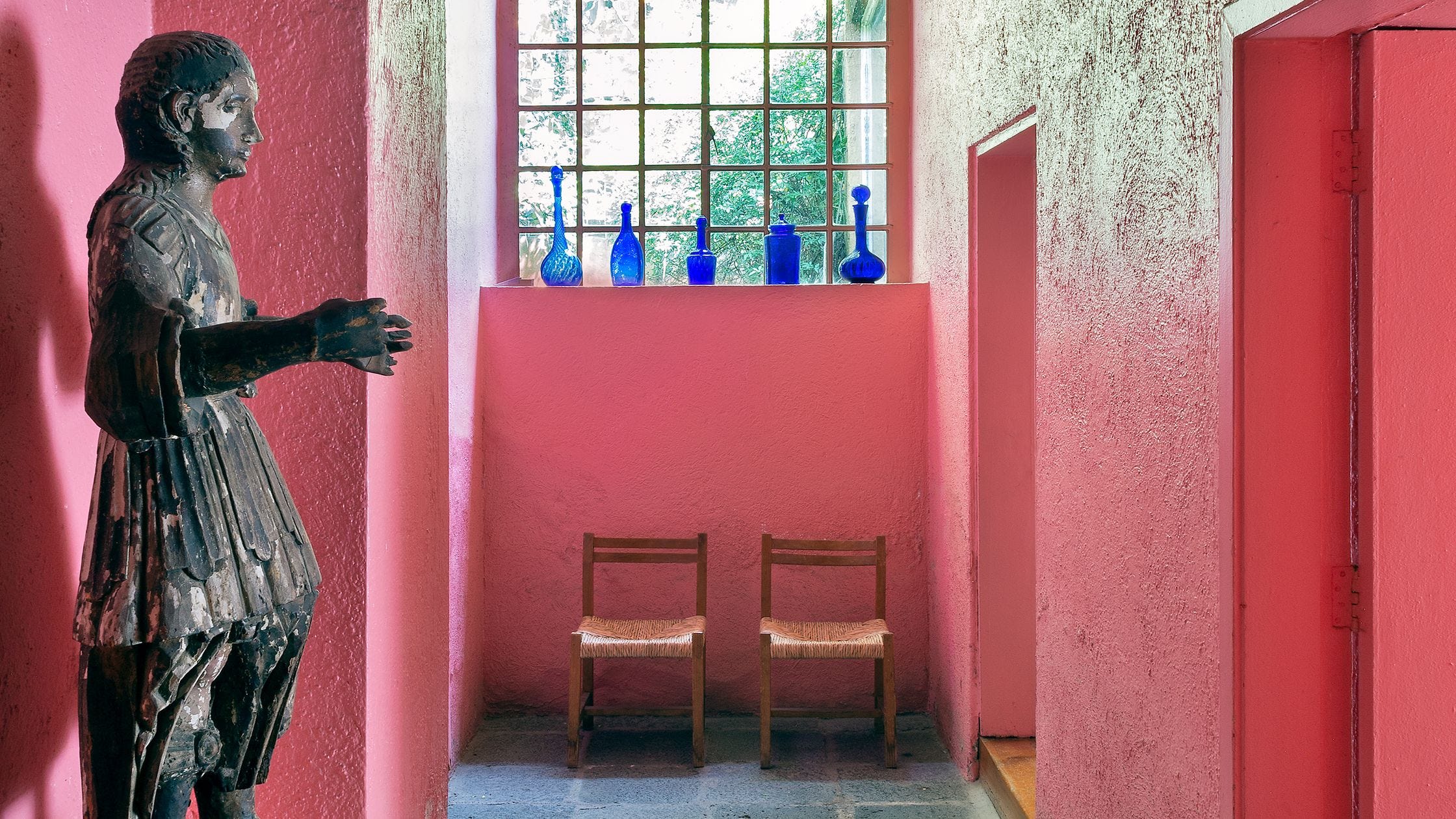
It was into this already highly developed culture of architectural surfaces that Luis Barragán arrived from Guadalajara and began building in Mexico City in the mid-1930s. Barragán’s crucial move was not to invent the textured wall but to radically simplify its architectural function: to strip away the ornamental vocabulary of Art Deco while retaining the sensuousness of the surface, combining roughness instead with saturated color, planar geometry, water, and light. Perhaps what makes this aspect of Barragán’s work so distinctly Mexican is precisely this transformation of the ordinary. He took the humble material qualities of local construction—the irregular plastered wall, the granular surface, the accumulated knowledge of vernacular building—and monumentalized them through abstraction, without erasing their material character. Roughness is not corrected or concealed; it becomes the means through which color receives light.
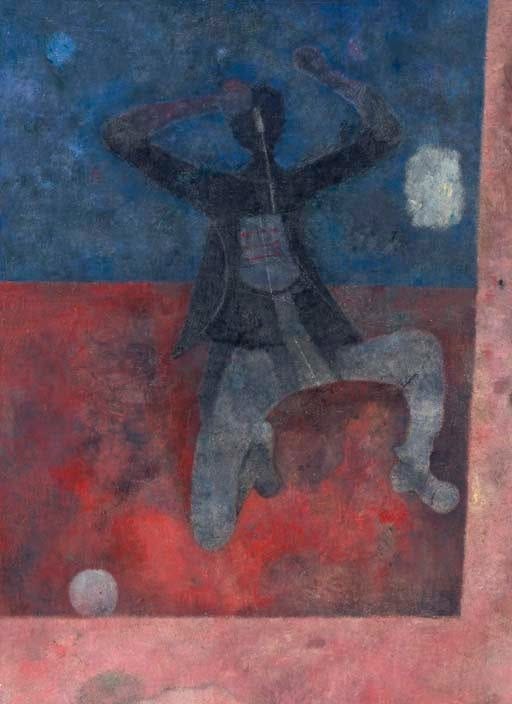
This provides a direct bridge to Mexican painting, particularly to artists working at a monumental scale who began to explore the material possibilities of the painted surface—most importantly, it seems to me, David Alfaro Siqueiros and Rufino Tamayo. Siqueiros was perhaps the most daring Mexican explorer of texture, relentlessly experimenting with industrial paints, unconventional tools, and new materials. But his materiality, like so much of his work, tends toward the dramatic, even the operatic: texture becomes an event. Tamayo’s approach is quieter and more painterly. In his work, texture enters into a carefully calibrated, almost alchemical relationship with color and light. His early engagement with Impressionism as a student—as well as Fauvism and Cubism—had already sensitized him to the atmospheric possibilities of color; the later incorporation of sand and other granular materials allowed him to pursue those possibilities through the physical surface itself. Color no longer simply occupies the surface: its material irregularities catch, absorb, and scatter light, giving it an atmospheric vibration. Tamayo’s material surfaces also place him within a broader postwar conversation that includes artists such as Antoni Tàpies, who similarly made matter central to painting, although often for very different expressive and philosophical ends. For Tàpies, matter frequently evokes the scarred, weathered, or wounded surface; for Tamayo, it remains above all a means of making color and light more palpable.
Looking at Tamayo, however, I keep returning to that powerful relationship between texture and light. During my student years, once I had recognized this as something I missed from Mexico, I tried to reproduce it in my own paintings. I made my own versions of textured surfaces, sometimes adding salt to acrylic mixtures, trying to understand what happened when color acquired a physical grain. The interplay of texture, color, and light became something of an obsession.
One morning, I woke up convinced that I had had an epiphany. I went directly to the TA in my painting class and tried to explain it to her. The problem was that I couldn’t put the idea into words—and, perhaps for that very reason, I couldn’t figure out how to put it onto a canvas either. I found this enormously frustrating. Looking back, I wonder whether this was my first recognition that painting alone could not contain what I was trying to do. The relationships I wanted to construct could not remain contained within a single surface. They needed to unfold across different media and, increasingly, through narrative and time.
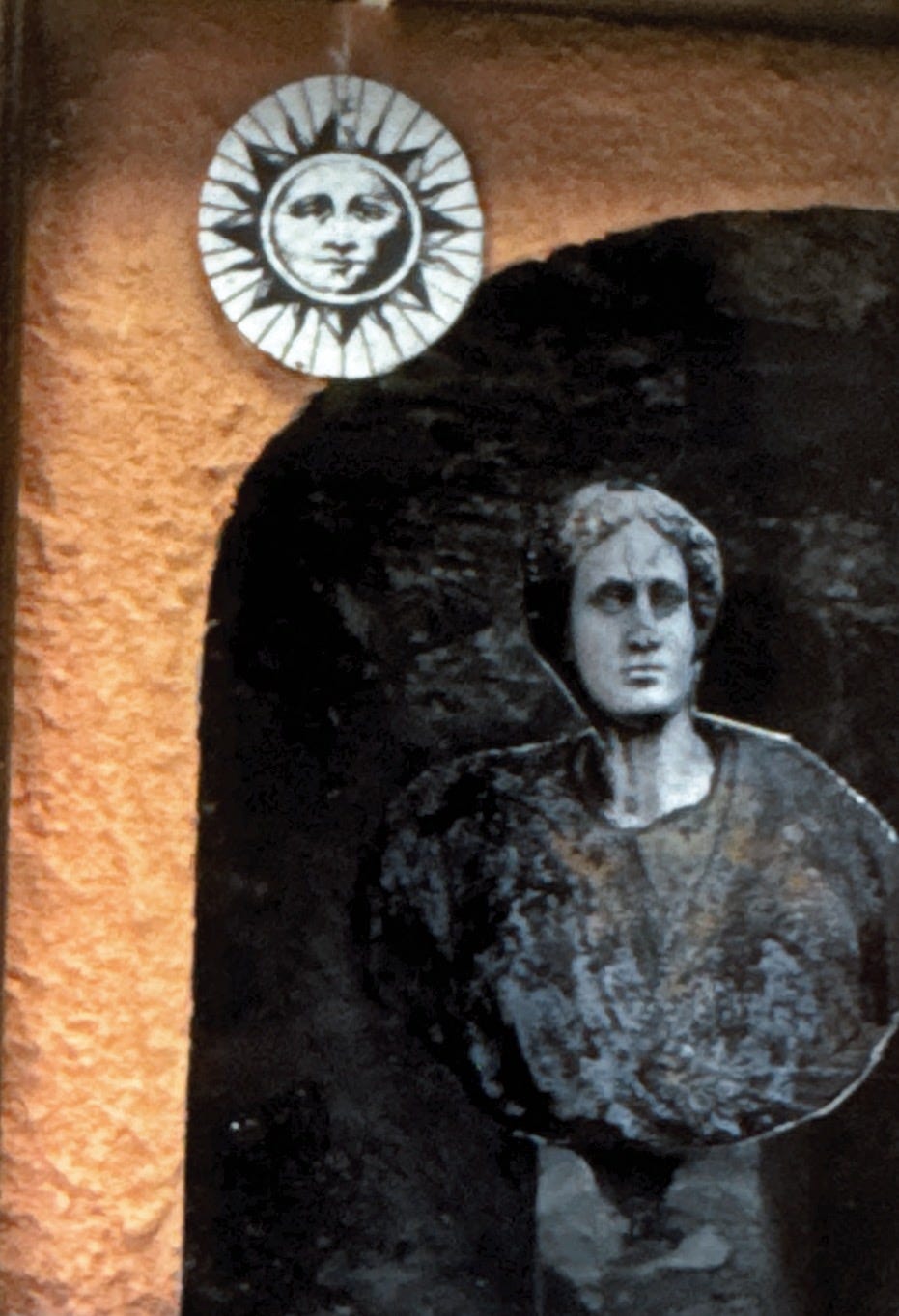
Which brings me back to Zacatecas. Looking at that wall in the courtyard that night, illuminated from below, I suddenly remembered the epiphany I had been so ineptly unable to put into words in art school. The texture seemed to contain an entire constellation of sensations and memories. I thought of my aunts Elsa and Elena, who loved opera, music, and elegant parties, and of the time they took me to a nighttime celebration of Mexican Independence—a spectacle that was at once vernacular and beautiful, full of a certain pride in the richness of a cultural tradition. Somehow, all of it seemed to be there: the rough wall, the colored light, the darkness, the music, the night air. Earlier that day I had gone looking for my grandmother’s house and found nothing to which I could attach a family memory. Now, unexpectedly, an anonymous wall was giving one back to me.
And then I remembered something stranger: I had apparently been trying to describe this sensation all along. In 1992, during my last year of art school, when I was twenty-one, I wrote in my diary:
“Through the passageway of time I will say what I am and what I have been, two opposites, two presences made of lights that never go away: the lights of the garden that illuminated the nights of childhood, our secret gatherings. They were the reminiscence of the party, of the first party I wanted to have one day, when my father took me, on a gray afternoon without light but beautiful in its chiaroscuro, to the hardware store to buy the colored lightbulbs that would hang forever from the vines, like an enormous Christmas tree, where I wanted to hide in a corner and lose myself among the branches, the moss, and the ornaments, where every light was the doorway to a new world of corners, glimmers, and secrets, and I wanted to hang from a branch, to disappear, or to live forever as a light, always present, always bearing witness to something I never knew exactly what it was, but whose existence somehow mattered; the end of a party, when no one came out into the courtyard anymore and everything had been left outside, illuminated though no one was there to see it, and because of this, when I went outside as a child, it seemed magical and sad to me, because somehow I sensed that I was in a place no one could see and that therefore was almost as if it did not exist, and that I was there, although sometimes I was not there either, I did not think of myself as a spectator or a witness or anything in particular, while at other times I did realize that I was the only one who was there, and that I was the only one who could save that vision for the world, and that made me feel important, and from then on the garden became a place I would always go at special moments; on many nights I felt that I had to go out to the garden after dinner, and I would step onto the terrace where the rusty, moldy outlet that Papá had installed years before was, and I was always surprised that it still worked, and that the colored lights of the garden would emerge from their hiding places among the vines, as though they had been waiting for that moment all along, always hidden away so that they could appear again the next time.”
And so, looking at this ordinary wall, decades of my life are projected across its surface like a film. The voices of people who are gone, places that have changed or disappeared, childhood gardens, colored lights, paintings I tried and failed to make—all of them seem somehow contained there. And so is the inexpressibility that frustrated me as a student. Perhaps I understand it better now: there are forms of knowledge that cannot be translated completely into language, because they reside partly in the body—in what light, color, smell, sound, and touch have taught us without our knowing it.
I cannot fully explain to you what I see in this wall. Perhaps that is precisely why I have spent a lifetime trying to make things. One makes works in the hope that what cannot be translated might nevertheless be transmitted: that a sensation can pass from one person to another without ever becoming entirely legible. Perhaps, if one is fortunate, those works can become surfaces onto which others project their own memories—other walls for others to read.
Enchanting
ohh, thank you for putting to words some of the feelings and experiences I have found so deeply enchanting about Mexico