
Interpretive Geographies
What Soviet Film Theory Can Teach Us About Exhibition Making.

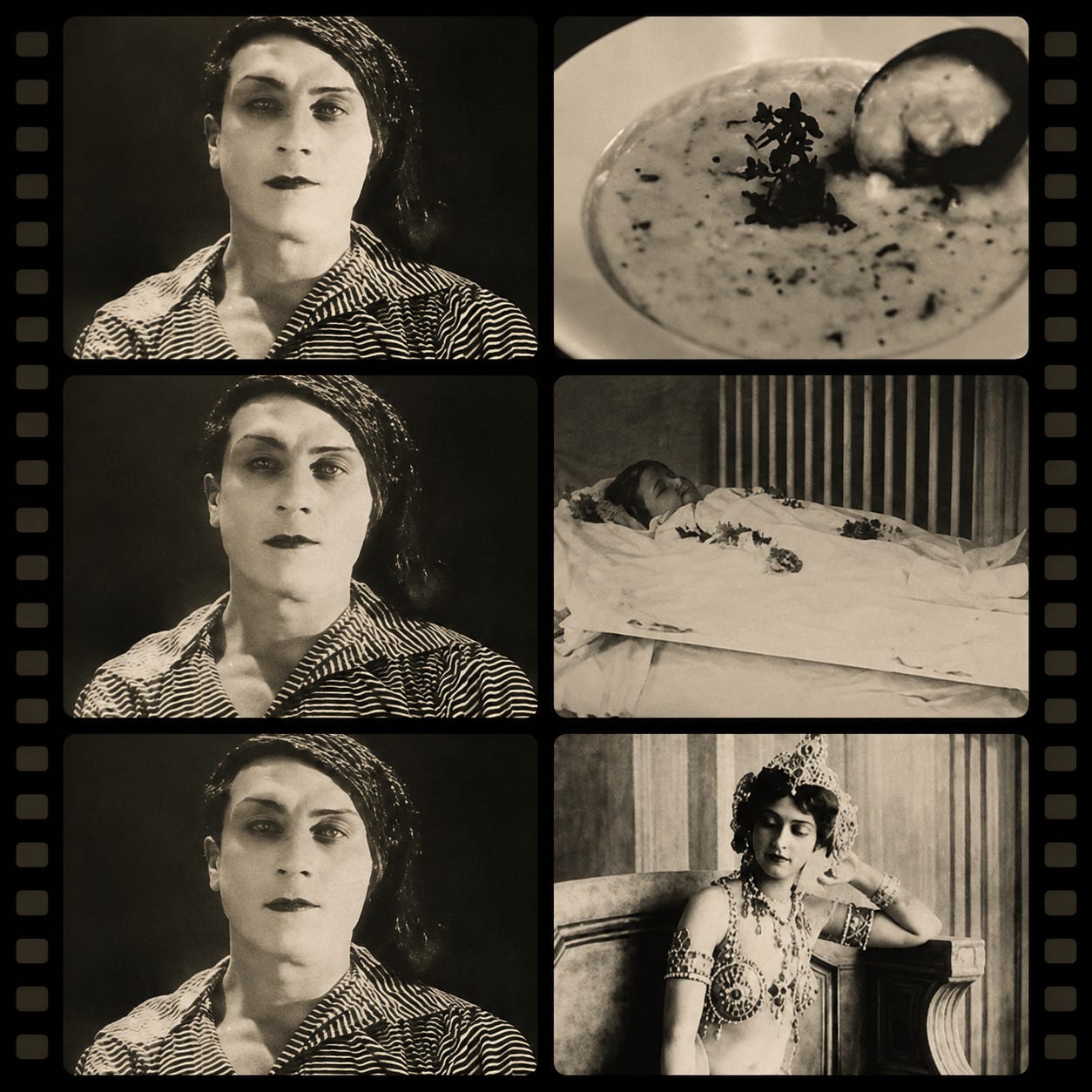
Sometime between 1918 and 1921, a young Soviet filmmaker named Lev Kuleshov devised what would become one of the foundational thought experiments of modern cinema. Whether it existed as a finished film, a classroom demonstration, or a series of editing exercises remains uncertain; the original has been lost. Yet the experiment would become central to the theoretical foundations of Soviet montage and, ultimately, to the history of film editing itself.
According to Kuleshov and his student and collaborator Vsevolod Pudovkin, the experiment consisted of a close-up of the celebrated pre-Revolutionary actor Ivan Mozzhukhin intercut with three unrelated images: a bowl of soup, a child lying in a coffin, and a reclining woman. The close-up of Mozzhukhin never changed. Yet audiences reportedly attributed entirely different emotions to the actor depending on the image that preceded or followed it. Paired with the bowl of soup, his expression appeared hungry; juxtaposed with the child, it conveyed profound grief; alongside the reclining woman, it suggested desire.
The circumstances of its creation were unusual. In the years immediately following the Russian Revolution, filmmaking was severely constrained by civil war, scarce resources, and an acute shortage of raw film stock. Unable to shoot freely, filmmakers often resorted to re-editing existing footage. Kuleshov, then teaching at the newly established State Film School in Moscow, later described this period as one in which cinema was discovering its own “grammar.”
This simple manipulation revealed a startling proposition: the meaning of an image does not necessarily reside within the image itself, but can emerge from its relationship to neighboring images. This phenomenon became known as the Kuleshov effect.
Kuleshov later theorized this idea in the 1920s under the term “creative geography” or “artificial landscape”. The experiment suggested that meaning is not an inherent property of an image but a consequence of its context. An image acquires significance through its neighbors. Although Kuleshov was speaking about cinema, the same principle extends far beyond film. Every exhibition, too, is an arrangement of juxtapositions whose meanings emerge less from individual works than from the larger context they collectively construct.
Kuleshov’s experiment belongs to a broader twentieth-century realization that meaning is often produced less by things themselves than by the relationships established among them. Around the same historical moment, Marcel Duchamp was arriving at a remarkably similar conclusion through an entirely different route. By relocating an ordinary urinal into the context of an art exhibition, Fountain demonstrated that objects are transformed by their surroundings. If Kuleshov revealed that editing could produce new meanings between images, Duchamp showed that displacement could produce new meanings around objects. In both cases, context ceased to be a passive container and became an active producer of meaning.
Curating occupies an unusual position within this lineage. Unlike artists, curators do not ordinarily create new works; they create new relationships among existing ones. Every exhibition is therefore an act of interpretive geography, relocating objects into conceptual neighborhoods that alter how they are understood. The exhibition becomes a map of meanings rather than simply a collection of objects.
Throughout the twentieth century, the curator’s role underwent a profound transformation. The early modern museum largely conceived of the curator as a custodian and historian, responsible for preserving objects and arranging them into coherent historical narratives. Although no exhibition was ever truly neutral, the aspiration was often one of scholarly objectivity: to illuminate rather than interpret.
As art history itself became increasingly self-reflexive, exhibitions gradually assumed a more editorial function. Curators no longer simply reconstructed historical sequences but proposed arguments about them, emphasizing overlooked genealogies, unexpected affinities, or alternative narratives. The exhibition became not merely a presentation of history but an interpretation of it.
By the late twentieth century—and particularly after the influence of figures like Harald Szeemann—the curator increasingly emerged as an independent cultural producer. Exhibitions became intellectual propositions in their own right, often organized around conceptual frameworks rather than chronology, geography, or medium. The exhibition itself came to be understood as a medium capable of generating new knowledge.
As the curator increasingly came to occupy the role of author rather than custodian, another consequence followed almost inevitably: the growing capacity to shape meaning through juxtaposition. If montage could transform the emotional meaning of a face without altering a single frame, exhibitions could similarly transform the perceived meaning of artworks without altering a single object. The exhibition became not only a site of presentation but a machine for producing interpretation.
This is neither inherently virtuous nor inherently problematic. On the contrary, it is one of curating’s greatest creative possibilities. Yet it also carries a corresponding responsibility. The stronger the curatorial voice becomes, the greater the possibility that the relationships it constructs begin to overshadow the works themselves. At its most illuminating, juxtaposition reveals affinities that had remained invisible. At its most tendentious, it recruits works into arguments they were never intended to make.
Some years ago, I was approached by a European kunsthalle to participate in an exhibition on a topic that closely pertains to my practice. The initial proposal was to co-curate the exhibition with a well-known local writer. I only agreed to participate in the exhibition as artist and as a dialogue partner with the curator to help shape the exhibition; I requested that my name appear only as an artist rather than as a curator. Early in the process one of its senior staff privately intimated that the reason I had been brought into the project largely to provide curatorial shape and contemporary art expertise was because the writer, who had great local prominence and evident political connections, had never organized an exhibition before.
Soon it became clear that our approaches to exhibition making were fundamentally at odds. Our meetings often began with the writer arriving with reproductions of artworks by little known artists he had found online that seemed to illustrate ideas he wanted to communicate. He had already written the essay; the exhibition, in his mind, was merely its visual counterpart. Rather than allowing artworks to generate unexpected relationships or challenge his argument, they were recruited to confirm it. We disagreed repeatedly—sometimes so intensely that both of us offered to resign—and although the exhibition was ultimately completed, the process was far more contentious than it needed to be.
It was only afterward that I understood what had troubled me so deeply. The problem was not simply his unfamiliarity with contemporary art, nor even his lack of curatorial experience. It was that he approached the gallery as if it were a book waiting to be illustrated. The exhibition became a lecture in spatial form: ideas first, objects second. Yet the most compelling exhibitions rarely communicate this way. Like Kuleshov’s experiment, their power lies not in explaining but in arranging. They create conditions in which meaning emerges through relationships rather than being imposed upon them. The curator’s task is not merely to tell visitors what artworks signify, but to orchestrate encounters through which viewers arrive at meanings themselves.
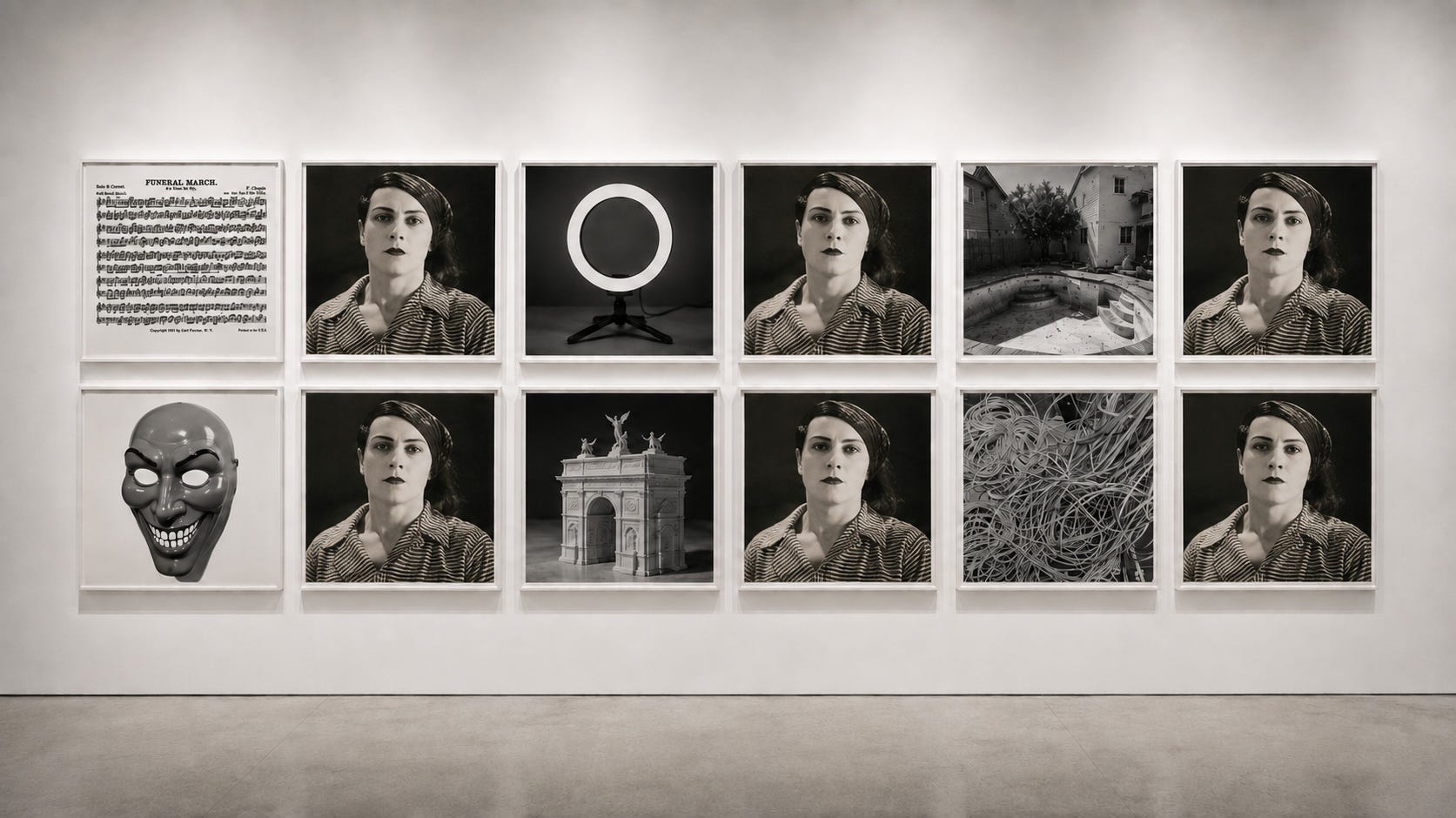
The previous example also suggests that the growing authorial ambitions of artists and curators come with a corresponding risk. The more determined we become to communicate a particular interpretation, the greater the temptation to construct exhibitions that function as illustrated arguments rather than as spaces of discovery. In my recent essay This Is So Didactic? I argued that audiences rarely enjoy being instructed; they prefer to arrive at meanings through their own intellectual labor. The same principle applies to exhibitions. The curator’s task is not simply to communicate ideas but to construct situations in which ideas emerge.
This, perhaps, is the real lesson of Kuleshov. Creative geography succeeds not because it manipulates viewers into predetermined conclusions but because it presents them with relationships whose significance they must actively negotiate. The most memorable juxtapositions are neither arbitrary nor merely illustrative. They inhabit a productive middle ground: sufficiently unexpected to provoke curiosity, yet sufficiently coherent to invite interpretation. Surrealist artists understood this well. Their pairings often appeared irrational, but they were rarely accidental. Their juxtapositions were meticulously calibrated to sustain ambiguity rather than eliminate it.
One might therefore distinguish between two forms of curatorial montage. One seeks to close interpretation by recruiting artworks into a predetermined thesis. The other opens interpretation by arranging works in ways that produce questions the viewer cannot easily resolve. The former persuades; the latter invites thought.


These questions were very much on my mind in 2003 when I developed a project titled Parallel Lives. At the time I had become increasingly interested in the role that curatorial interpretation plays in constructing meaning. If Kuleshov had demonstrated that editing could radically alter the perceived meaning of an image, I wondered whether language could perform a similar function within the exhibition itself. To what extent could interpretation reshape an exhibition without changing a single object?
Parallel Lives consisted of a single installation accompanied by five completely different audio guides, each narrated by the artist Fred Wilson ( I remember my shameless audacity in asking Fred whether he would do the audio guide; it was symbolically important to me to have his voice as a foundational figure of institutional critique; he generously agreed).
The exhibition never changed. Only the narrative did. Each guide presented the objects as evidence in the life of a different historical figure or community: the Renaissance philosopher Giulio Camillo, the eccentric soprano Florence Foster Jenkins, the Shakers, the Guggenheim archivist and painter Ward Jackson, and Friedrich Fröbel, the inventor of kindergarten. Every object acquired five distinct identities depending on the biography through which it was encountered.
A small house assembled from kindergarten blocks, for example, became five different objects without physically changing. In one narrative it illustrated Fröbel’s pedagogical theories; in another it became a reconstruction of a Shaker meeting house; in another it evoked Giulio Camillo’s “memory theater” and the mnemonic use of architectural space. The object itself remained constant. Its meaning migrated.
Looking back, I realize that Parallel Lives was less an exhibition than an experiment. It sought to test the extent to which objects in museums function not as fixed containers of meaning but as receptors of meaning, absorbing different interpretations according to the conceptual geography in which they are placed. The project suggested that exhibitions are not simply arrangements of objects but arrangements of possible readings.
In the end, the Kuleshov effect raises a fascinating question not only for filmmakers but for anyone who makes exhibitions. To what extent are works of art vessels of intrinsic meaning, and to what extent are they surfaces upon which meaning is projected? Every curator, whether consciously or not, answers this question through the exhibitions they make.
If one believes that artworks possess stable meanings waiting to be revealed, then the curator’s task is largely one of faithful interpretation. But if meaning is understood to emerge through relationships—between objects, spaces, histories, texts, and viewers—then curating becomes something altogether different. It becomes the art of constructing interpretive geographies.
Perhaps this is why Kuleshov’s experiment still matters, more than a century later. It is not simply a lesson about cinema or even about exhibitions. It is a lesson about interpretation itself. We are all, whether we realize it or not, editors working in a cutting room. The fragments of history, politics, memory, and everyday experience arrive before us incomplete and often disconnected. We rarely choose the footage we inherit. What we do choose is how we assemble it, what relationships we draw between its parts, and what possibilities for meaning we leave open. We cannot avoid editing reality; the question is whether we edit it in ways that expand the possibilities of understanding or merely confirm what we already believe.
i’m not surprised that this thought came so early in film history. i devised an analogous theory when i was in college, only i called it “image streams”.
I really loved this essay, learned a great deal from it and read it at a propitious time when I have been mulling over collaborative conflicts and opportunities!! Humility, risk and trust vs. pride!!!!!! Thank you for the provocation :).