

Dear ____,
I have kept your name anonymous for three reasons. First, because I suspect you are more likely to read it here than if it were to find its way into your inbox as a personalized letter. Second, I do not want to place you in the uncomfortable position of having to manufacture plausible deniability—pretending you never received my message—or of awkwardly acknowledging it the next time we meet at an opening, explaining how busy you’ve been and that you’ll get back to me. And lastly, I do so because for the public purpose of this letter, our respective names matter little: what I am going to describe is, I think, rather representative of countless artists like me, and countless curators like you—all caught in the daily predicament of either rejecting or being rejected.
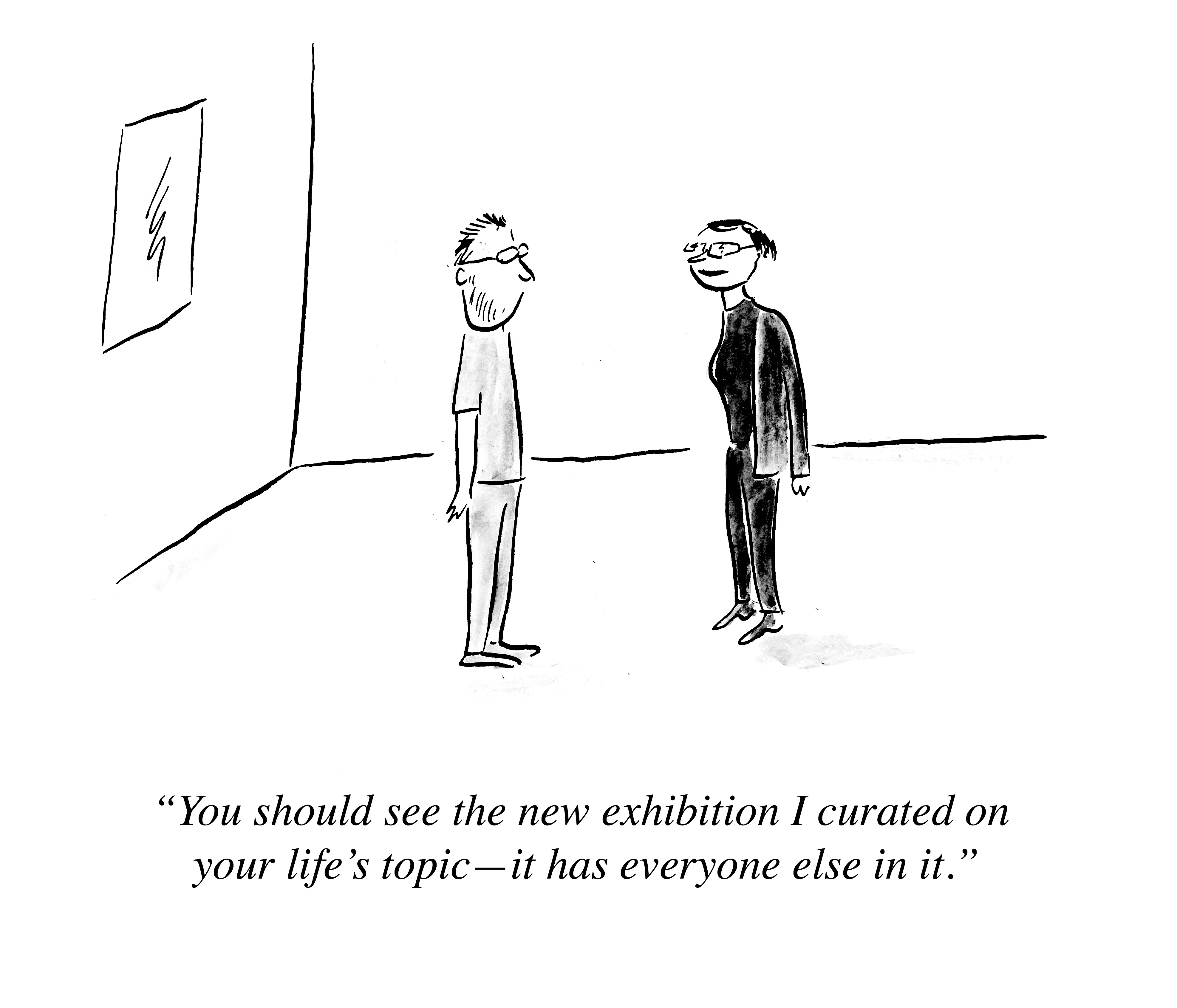
We have known each other long enough that I have forfeited the chance to remain a mysterious, intriguing figure in your eyes. Familiarity breeds contempt. But the truth is that even when we first met we did not quite connect—or at least, you did not seem to connect with me. While I always wanted to work with you, as practically any artist wants to work with a curator, I was also keenly aware that you did not want to work with me. We have always been cordial in our greetings and in the many places we intersected professionally, and I always made sure you knew what I was working on (everyone in the art world knows what everyone else is working on anyway, even while denying it; feverishly nosy and addicted to updates as we all are). At the only studio visit you did with me, the comment that stuck with me the most (and which I am sure you have long forgotten) was about the artist who was making work similar to mine, and who preceded me. Later, you organized a show on a subject I have devoted myself to for the better part of a decade—a show to which I was conspicuously not invited. It felt as if I were a baker specializing in strawberry shortcake, and across the street there was a strawberry shortcake festival, with every baker in town invited except me. I know I am not imagining this, because once a collector friend enthusiastically spoke to you about my work, unprompted, and later told me in confidence that your response had been sepulchral silence. “There is no interest there,” he said to me, somberly, as if delivering a grave medical diagnosis. The signs were unmistakable: the dislike is real, there is nothing to do, and I simply have to live with it.
It might sound inauthentic, but I do sympathize with you. I recognize that I, too, enact the same avoidance strategies, as pretty much all of us do. There are dozens of people we know in the art world who long for deeper professional relationships with us, but we are simply not into them, which partially makes me wish that you didn’t have to ever deal with me. Other times we love the person socially, even enjoy their company, but cannot respect their work. The inescapable fact is that we are both professionals—neither of us so terrible as to be forgotten entirely—and, to put it in operatic terms, fate’s power (La Forza del Destino) has placed us in the same time and place for the span of our artistic lives.
In such circumstances, brutal honesty can sometimes be a relief, however painful. A curator who disliked me once told me so directly; her honesty, rare as it was, felt liberating in its clarity, for it allowed me to know exactly where I stood. Another, a dear friend, would tell me when they did not like a particular work of mine, which I valued deeply, since it showed they cared for the larger body of my practice. But as the years passed, they stopped commenting altogether, which I took to mean that their interest in my work had withered; silence became the only option left to them. We remain friends, which perhaps makes it worse.
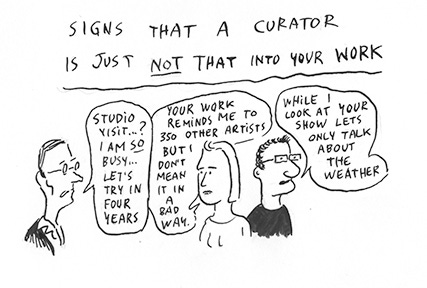
The art world is not good at honesty. Instead we hide behind schedules and busyness to avoid direct confrontation. As artists, there is little we can do except endure it and suffer in silence. (I am well aware that there are of course far worse calamities in life; in the larger scheme, the obsession with being overlooked is absurd when genocide is happening in the world, as I am sure many will point out. So I hope my comments, however frivolous, may at least prove entertaining.)
I will always work hard to be a better artist, but regardless of that effort it is clear that I will likely never be likable to you. Sometimes the rejection is almost biological: a curator once confided in me, “I know I should work with that artist, but I just can’t stand his face.” Better put, perhaps: it’s a matter of chemistry. In the periodic table, the term is immiscibility—the condition of substances that cannot mix into a homogeneous solution. Oil and water, mercury and iron, helium and argon: they do not repel one another, but neither can they blend.
Convention and social acceptance will prevent us from ever speaking openly about this. To do so would only diminish the one who says it aloud. The passing this week of a curator friend reminded me of this fact. He was director of a major museum in Mexico. A failed painter and adversary of his, politically connected to the ministry of culture, once declared in an interview that my friend was incompetent and knew nothing about art. To prove it, he forced the museum to host an event promoting a catalogue of his own works. The minister of culture, a political hack, called my friend to insist the event take place. My friend responded in the only honorable way possible: he resigned. Today his reputation is secure; he is remembered as a major figure in the history of that period of Mexican art. Meanwhile, the vindictive painter who tried to humiliate him has already receded into oblivion; in another decade, no one will even remember his name.
One of the art world’s unspoken protocols is the mutual silence between curators and artists when it comes to dismissing each other’s work. A curator may quietly disregard an artist, and an artist may quietly dislike a curator’s program, but to voice that judgment openly carries a peculiar risk. It is a version of Pascal’s wager: since posterity has the power to overturn present judgments, we hedge our bets by withholding dismissal. To ridicule an artist who later becomes canonical—or to belittle a curator who later proves visionary—is to guarantee that one’s earlier disdain will be remembered as arrogance or stupidity. Silence thus becomes less courtesy than insurance: a recognition that the value of art, and of those who mediate it, is always decided elsewhere, and later.
So I salute you in this strange, unspoken pact of silence—one where our mutual suspicions about each other will remain forever sealed, but where you know that I know that you know that I know. And I also know, as I hope you do, that in this world devoid of universal acceptance we must be grateful for those—whoever they may be—who value the work we do. For both your work and mine will find recognition—if not here and now, then in some other time, in some other place.
Yours truly,
Pablo
True.
I love this!