Love as Armor
Witnessing Latino Civil Resistance in Minneapolis

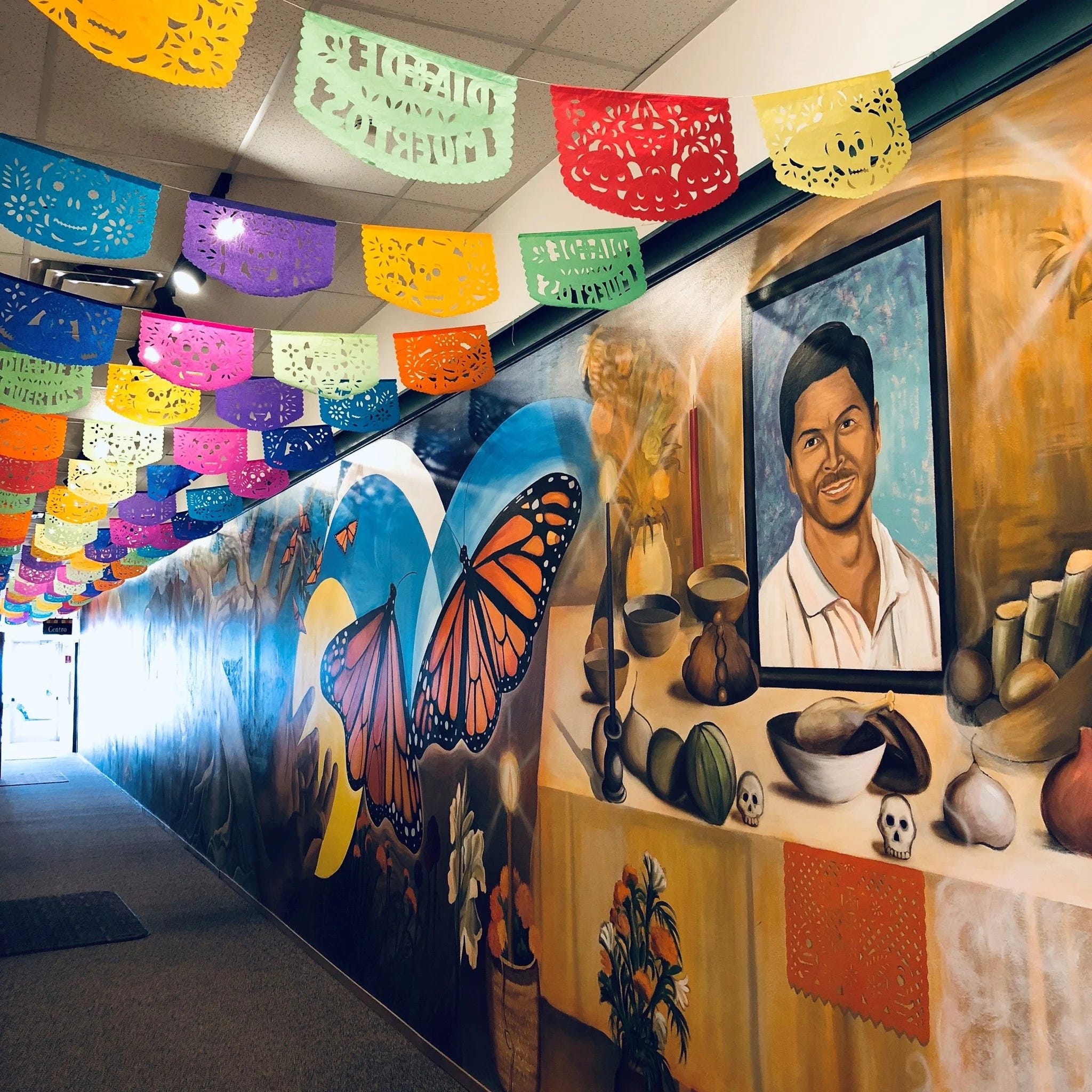
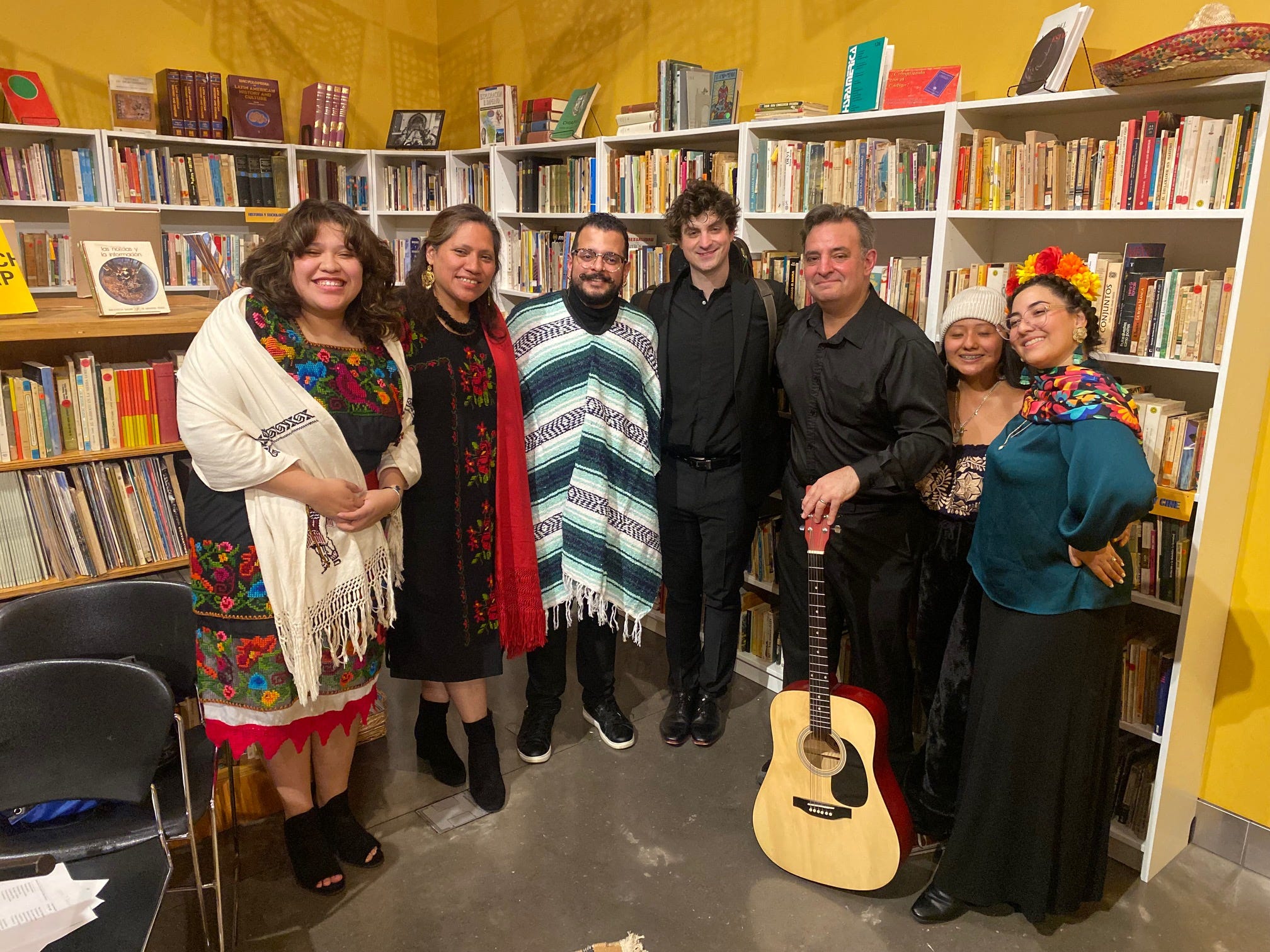
In October 2025, I traveled to Minneapolis to launch my itinerant Spanish-language used bookstore, Librería Donceles, at the Weisman Art Museum, where the project remains installed today. Wherever the bookstore travels, it partners with a local Latino organization that receives the proceeds from book sales. In Minneapolis, Alejandra Peña and Katie Covey—Executive Director and Director of Education at the Weisman— rightly suggested for the proceeds to go to Centro Tyrone Guzman, an institution whose role in the city extends far beyond the cultural sector.
A visit to Centro Tyrone Guzman immediately recalled my early years working in Chicago’s Mexican neighborhood of Pilsen. Like many historically Latino cultural centers, Centro Tyrone operates simultaneously as a community refuge, an educational institution, and a cultural space. Founded in 1974 as a Chicano cultural center, it has sustained intergenerational programming for decades and today runs Siembra Montessori, a bilingual early-childhood education program widely recognized as a national model.
For that reason, when reports of ICE raids began emerging across Minneapolis in recent weeks, my concern turned immediately to Centro Tyrone Guzman and the families it serves. Yesterday, I spoke with the center’s Executive Director, Xavier Vázquez, and Development Director, Ena Castilla. Their account describes a situation marked by fear, disruption, and profound uncertainty—one that is already reshaping daily life for Latino families across the city. What follows is drawn directly from that conversation, in order to convey the gravity of what is happening in Minneapolis right now.
“What have you heard about what’s happening here?” Xavier asked me early in our conversation — a question that pulled me up short. I told him what most of us outside Minneapolis know: that two U.S. citizens, Renée Good and Alex Pretti, were recently shot and killed by federal agents during immigration enforcement operations, igniting large protests and national outrage. Yet beyond those headlines, many of us lack direct, first-hand insight into the day-to-day reality for families and neighbors in the city.
What Xavier confirmed is that the level of harassment, fear, and sense of siege reaching Minneapolis communities far exceeds what most media coverage has conveyed. The incidents aren’t isolated moments of violence — they are part of a broader pattern of aggressive federal enforcement that residents describe as deeply destabilizing, traumatizing, and pervasive in the neighborhoods where children go to school, people go to work, and families try to live their everyday lives.
Xavier described a pattern of enforcement that operates less like lawful procedure and more like an atmosphere of constant pursuit. People, he said, are being detained in minutes—pulled into unmarked vans by agents wearing civilian clothes, often driving vehicles with out-of-state plates or no plates at all. These arrests, he emphasized, frequently happen without warrants or verification of legal status. “They are not even checking,” he told me. “They are just grabbing people.”
Some of the most disturbing incidents involve children. Xavier recounted cases in which minors were used as leverage to apprehend parents, including one involving a child with autism who was allegedly used as a pretext for an arrest. In another instance, a father from Centro Tyrone’s school community was detained on December 12 and transferred to Nebraska overnight. Only sustained community pressure—letters, court appearances, and collective advocacy—secured the release of another parent arrested days before Christmas.
Fear has reshaped daily life. Families avoid leaving their homes except when absolutely necessary, even for medical emergencies. Xavier described people being detained inside hospital emergency rooms and others arrested after simply eating at a Mexican restaurant. Some children, he said, have not attended school for months. Classes are virtual. Businesses remain shuttered; grocery stores and restaurants have closed for weeks at a time. Volunteers now escort people one by one into buildings, and Centro Tyrone has shifted much of its programming online as staff work from home for safety.
The tactics, according to Xavier, are deliberately deceptive. Agents reportedly pose as Amazon delivery workers, trigger fire alarms to force people outside, and intimidate witnesses with veiled threats. “They tell people, ‘Didn’t you see what happened to Renée?’” he said. The message, he explained, is unmistakable: compliance through fear. What emerges from these accounts is not a series of isolated incidents, but a sustained campaign of pressure that has turned entire neighborhoods into spaces of vigilance and dread.
What is most breathtaking in these accounts is not only their brutality, but their provenance. These are not clandestine militias or rogue actors operating in the shadows; they are U.S. federal agents, acting openly, in broad daylight, within the borders of a democratic state. Yet the methods described—unmarked vehicles, disguised officers, rapid detentions without explanation, the apparent suspension of due process—more closely resemble paramilitary operations than civilian law enforcement. The power being exercised appears extrajudicial, and its deployment nearly absolute. That such actions are unfolding with what looks like total impunity, in American cities and against American residents, marks a profound rupture in the relationship between the state and the people it claims to serve.
Listening to Xavier and Ena speak made it clear that they were deeply distraught by what they are witnessing, but they were also exhibiting extraordinary resilience. That fortitude, they told me, does not come from denial or optimism, but from the community itself. In response to fear and isolation, neighbors have organized informal yet highly coordinated systems of mutual aid—volunteers accompanying people to appointments, helping reopen businesses one person at a time, delivering food, and ensuring that no one is forced to face these conditions alone. As Xavier put it, “La comunidad se organizó sola. La gente dijo: ‘No podemos quedarnos aislados.’ Creamos redes de voluntarios para acompañarnos, para abrir los negocios poco a poco, para protegernos unos a otros.” Xavier pointed out that also non-latino Minnesotans have been crucial allies and support to the community.
The question that inevitably hangs over these conversations is a simple one: when does this end? The answer, according to Xavier and Ena, is likely not soon. Today there are reports that Border Patrol Commander Gregory Bovino and some of his agents are expected to leave Minneapolis amid intense public backlash after the fatal shooting of Alex Pretti, and the broader controversy that has erupted nationwide. However, federal enforcement in the city shows no sign of disappearing anytime soon. Xavier explained that agents have secured long-term hotel arrangements—including extended stays and new contracts—which suggests that the operations unfolding in Minneapolis are planned to last months rather than days. In spite of the temporary lull, the struggle, then, will likely be a long one. And yet, despite the provocations, despite the exhaustion and the deep sense of impotence that such conditions produce, Xavier was unequivocal about what must not be surrendered. “Eso es lo que quieren,” he told me—que reaccionemos con rabia. “Pero no podemos tomar ese anzuelo. Tenemos que responder con paz.” The insistence on remaining peaceful, he said, is not passivity; it is a strategy of survival, dignity, and collective protection in the face of overwhelming power.
In moments like this, institutions reveal what they are truly made of. What I witnessed in my conversation with Xavier, Ena, and the staff of Centro Tyrone Guzman is nothing short of extraordinary. Under immense pressure and constant threat, they continue to show up—not only as administrators or cultural workers, but as neighbors, organizers, and caretakers. Their response offers a living model of what civil resistance can look like today: grounded not in spectacle, but in mutual aid, cooperation, and an unwavering commitment to collective dignity. If there is a way to stand with them beyond bearing witness, it is by helping sustain this work. I urge readers who are able to consider making a donation to Centro Tyrone Guzman, so they can continue supporting local businesses, families, and a community navigating an ongoing siege with courage and grace.
The Nicaraguan poet and priest Ernesto Cardenal once wrote, in 1964,
Al que no cree en la mentira de sus anuncios comerciales
ni en sus campañas publicitarias ni en sus campañas políticas
tú lo bendices
Lo rodeas con tu amor
como con tanques blindados
The line feels painfully current today, as communities practicing care, restraint, and cooperation are met with overwhelming force—and yet refuse to surrender their humanity. Let’s help them in that urgent task.
Donations to Centro Tyrone Guzman can be made here:
Reason will prevail!
This is not the « country » I use to know and love! And the people who gave me “asylum” during my Student years in Chicago 35 years ago!
All my « soutien/care » and love to all communities in U.S. ; from France, where I wish you to witness again A Great Democracy Again!
Did in France.
Tremendo lo que está pasando.
(Y los yanquis jactándose de ser el país más libre jajajaja NOT)