Maroon Elegy
Parting notes for 2025, with an oak finish

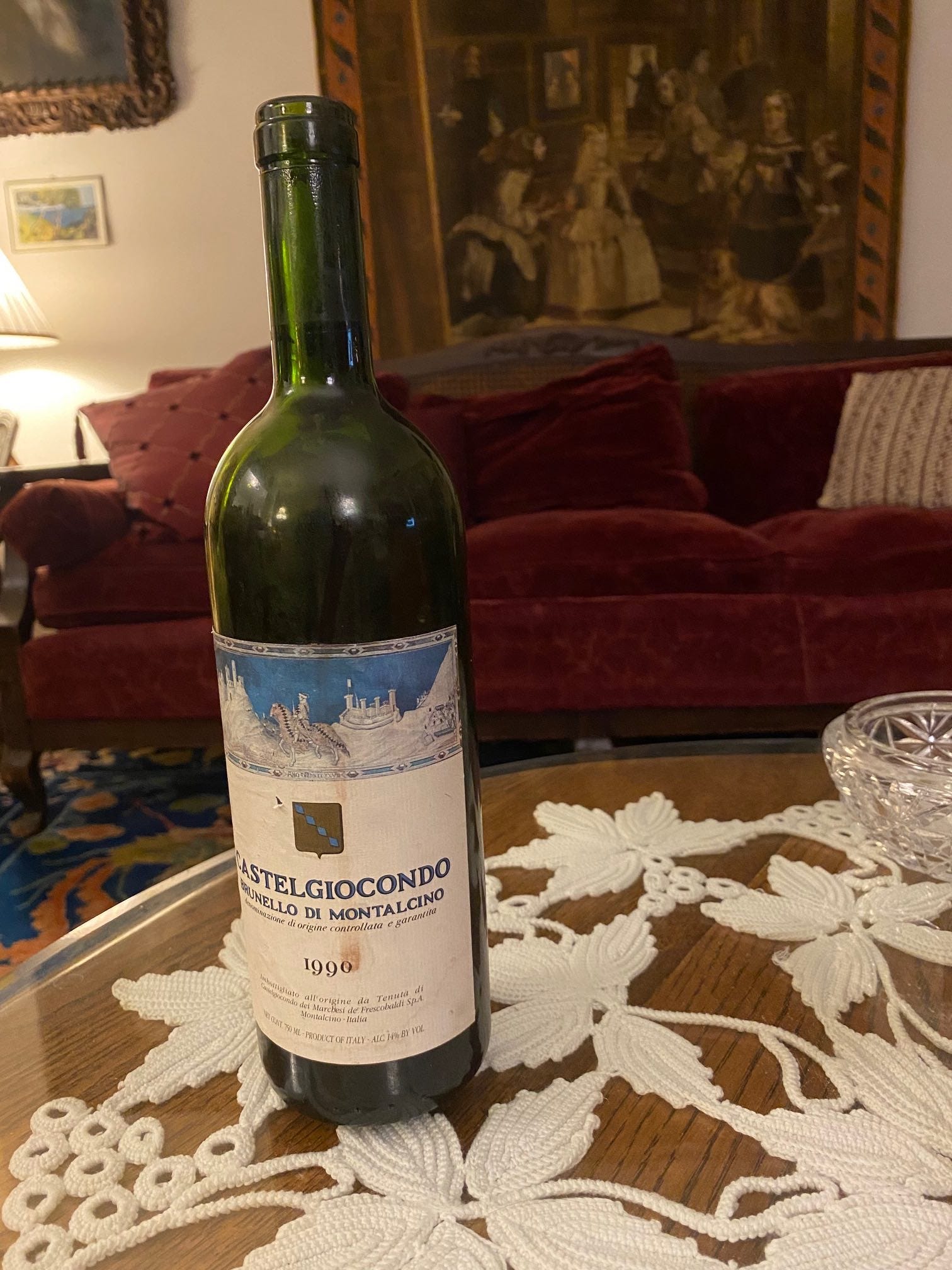
It is about two hours before midnight on December 31st, 2025, and I find myself—as I often do on the last day of the year—sitting in my mother’s apartment in Arlington Heights, Illinois. The living room, furnished with pieces my family brought from Mexico thirty‑five years ago, feels less like a domestic space than a small, accidental museum of time. My grandfather, the story goes, salvaged the maroon velvet curtains from the José Rosas Moreno theater in Lagos de Moreno, Jalisco, and used them to upholster the furniture that now surrounds me. Because of this, maroon is a color I instinctively associate with my family’s past. To my left is an old sofa where, according to a photograph, my father once sat as a newborn nearly a century ago.
Tonight I decided to open a bottle of 1990 Castelgiocondo Brunello di Montalcino—a gift from a high‑school friend in Mexico, given to me in the 1990s, carried across borders, and never opened. I am no wine expert, and am often perplexed by the baroque lexicon used in wine tasting— but also find interesting to have a settled vocabulary for experiences that unfold slowly and resist naming. Anyhow, something about the imminent arrival of the new year made the bottle feel finally ready. Friends who know more about wine than I do insisted that this was the moment: the wine had reached late maturity; it would never be better than it is now. With some care, I broke the seal and removed the old cork intact. It felt like a small ritual for marking time—and perhaps, more specifically, for marking my family’s migration from Mexico to the United States, also thirty‑five years ago.
The wine was initially disconcerting. Its first impression was a sharp burst of alcohol and volatility, something I was told is not uncommon in a thirty‑five‑year‑old Brunello. After a few minutes, that intensity receded, making room for other sensations: dried cherry, oak, earth. I could feel it in my nostrils, like standing too close to a memory. And yet the flavor lingered with an unexpected depth—dry, wooden, earthy—as if I were drinking an old forest.
It did not offer freshness or ease. It offered something that resisted summary, something that demanded accumulation rather than definition. Like certain artworks, it required time and return; each sip felt less like a conclusion than a revision. The flavors arrived in layers, not unlike the way we revisit art works, each viewing partially obscuring and partially revealing what had been seen before. This wine was less an object of consumption than an aesthetic experience—one that carried within it the dense memory of a place.
I found myself thinking of Fauré’s Elegie in C minor, a piece my family both played and listened to repeatedly, whose quiet power lies not in immediacy but in the way its melancholy unfolds over time, never insisting on itself. Sitting here now, tasting this maroon‑colored wine in the familiar maroon‑velvet living room of my childhood, surrounded—if only imaginatively—by generations who once sat in these same chairs, the year 2025, terrible in so many respects, is expiring in less than two hours.
This moment of complexity and richness does not feel celebratory so much as transitional: a coda, or perhaps a promissory note. I do not wish you “interesting times”, which we know is a traditional no blessing, nor do I wish you a happy and prosperous new year, a phrase too smooth to be believable. What I wish instead is that you encounter the coming year with the same complexity and richness held in this wine and in this moment—the contained forestry of it, dense with memory, demanding time, and impossible to exhaust in a single pass.
I am aware, of course, of the irony—and even the slight absurdity—of my own nostalgia. I have always loved welcoming the new year within the sentimental choreography of a traditional family setting, with its inherited rituals and familiar furniture. Back in 1999, carried away by that impulse, I suggested that we welcome the new century in our historic family house in Lagos de Moreno, Jalisco. My brother responded without hesitation with his characteristic sarcasm: “That would be like welcoming the twenty-first century in the eighteenth.” He was right, of course, and I remember laughing then, as I do now, at the gentle precision of his correction. I will never be entirely of my time; but then again, I am not sure any of us ever truly is. Just as there never are definitive, solid positives or negatives—only dullness or complexity.
Thank you for reading and thinking alongside me.
Beautiful music to begin 2026!