
Sadder Tropics
How do we distinguish a living ritual from a dead choreography?

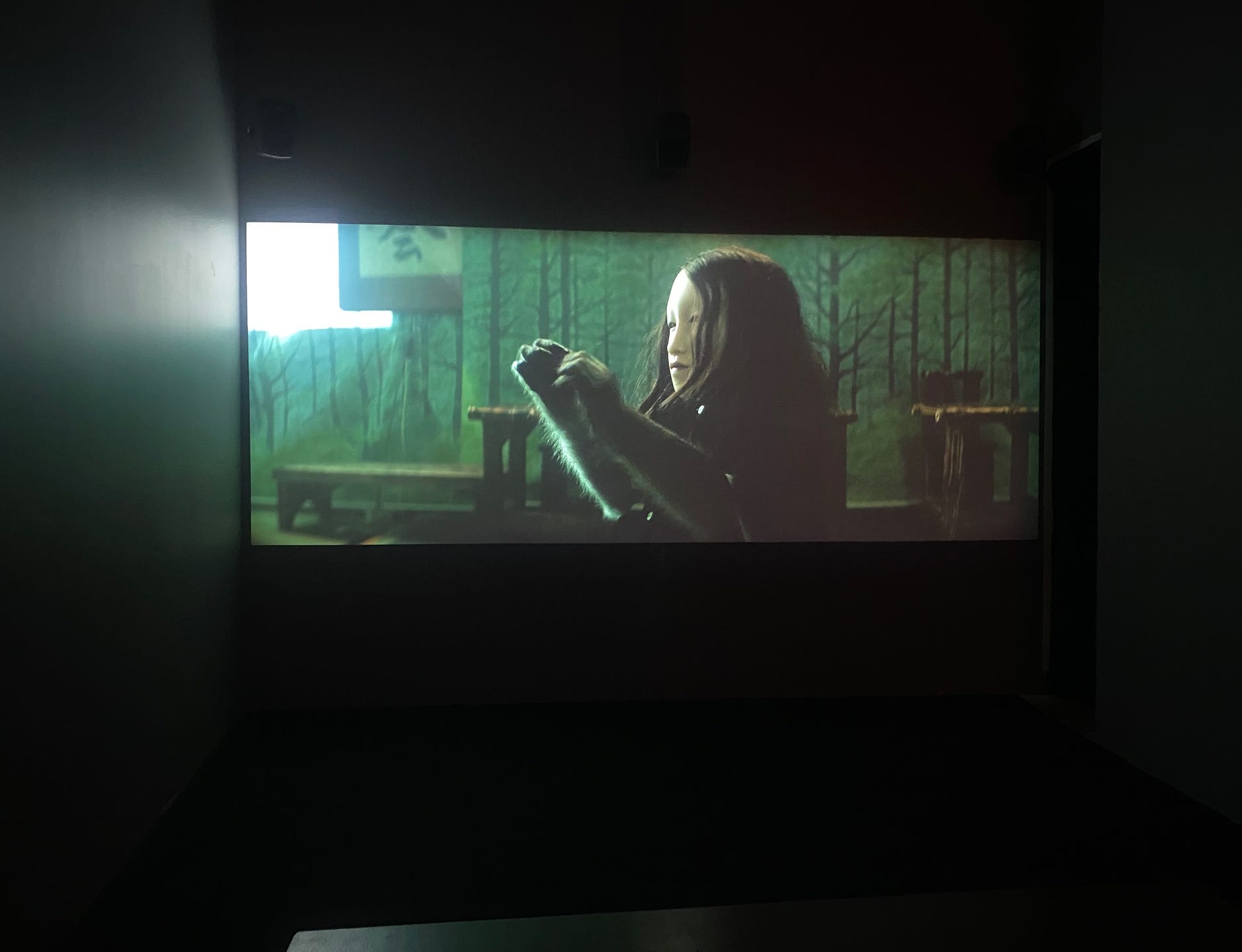
This weekend I finally made it to the newly expanded New Museum—only three months after it reopened (I have a remarkable talent for arriving late to things). Its current exhibition, New Humans: Memories of the Future, is one of the most affecting group shows I have seen in some time, and uncannily attuned to the historical moment we are living through. Biennial in both scale and ambition, it is almost impossible to absorb in a single visit—perhaps a show designed for posthuman attention spans rather than ordinary ones. Yet amid its abundance were several works that stayed with me long after I left.
One of them was Pierre Huyghe’s Human Mask (2014), a haunting nineteen-minute film set in the abandoned exclusion zone surrounding Fukushima, Japan. Inside the ruins of a deserted restaurant, a macaque wanders alone wearing a woman’s wig, a dress, and an expressionless white Noh mask. It continues to perform the serving gestures it was painstakingly trained to execute, moving through empty rooms where there are no longer any customers to receive them.
Inspired by a real-life restaurant in Japan where monkeys were trained to serve patrons, Huyghe removes the social world that once gave those actions their function. What remains is behavior detached from purpose: a choreography that persists after the reason for its existence has disappeared. The monkey repeats its routine with mechanical fidelity, as though unable to distinguish between habit and necessity.
The film elicits a cascade of emotions. There is first the uncanny spectacle of this almost-human figure, its expressionless mask at odds with its unmistakably animal body. Very quickly, however, the experience becomes an ethical one. We cannot help but wonder what it meant to train a macaque to perform these gestures, to dress it in human clothes, to transform it into a surrogate person for our amusement. The film does not let us forget that behind the mask is not a symbol but a living creature, one whose own desires and bewilderment remain inaccessible to us. The monkey itself becomes part of the artwork’s moral terrain.
Yet this ethical discomfort gradually gives way to another realization. The dominant emotion becomes sadness, followed by recognition. The monkey embodies the bewilderment of inhabiting a world whose logic has disappeared, continuing to perform gestures that once had purpose but now survive only as ritual. Before long we realize that the figure on screen is not simply a monkey wearing a human mask. It is, in unsettling ways, ourselves.
Before unpacking this further, it is worth turning to Byung-Chul Han’s The Disappearance of Rituals (2020). Han argues that rituals are not merely repetitive actions but symbolic forms that orient us in the world. They structure time, relationships, and communal life by pointing beyond the individual toward something larger than the self. Contemporary life and technology, he suggests, has hollowed out many of these forms, leaving behind gestures that continue long after the worlds that once sustained them have begun to disappear. Han is primarily interested in explaining why rituals are disappearing. But Human Mask led me to wonder about what happens when rituals continue only as muscle memory. What if their forms survive after the symbolic worlds that once animated them have eroded?
Perhaps it mattered that I encountered Human Mask on the Fourth of July. Later that evening, watching the ceremonies unfolding in Washington, I found myself thinking again about the monkey wandering through the abandoned restaurant. The fireworks, speeches, military displays, and commemorations retained all the outward choreography of civic ritual. Yet much of it felt detached from the historical imagination and civic confidence that had once animated those forms. The spectacle resembled a stage set still dutifully occupied after the audience had left.
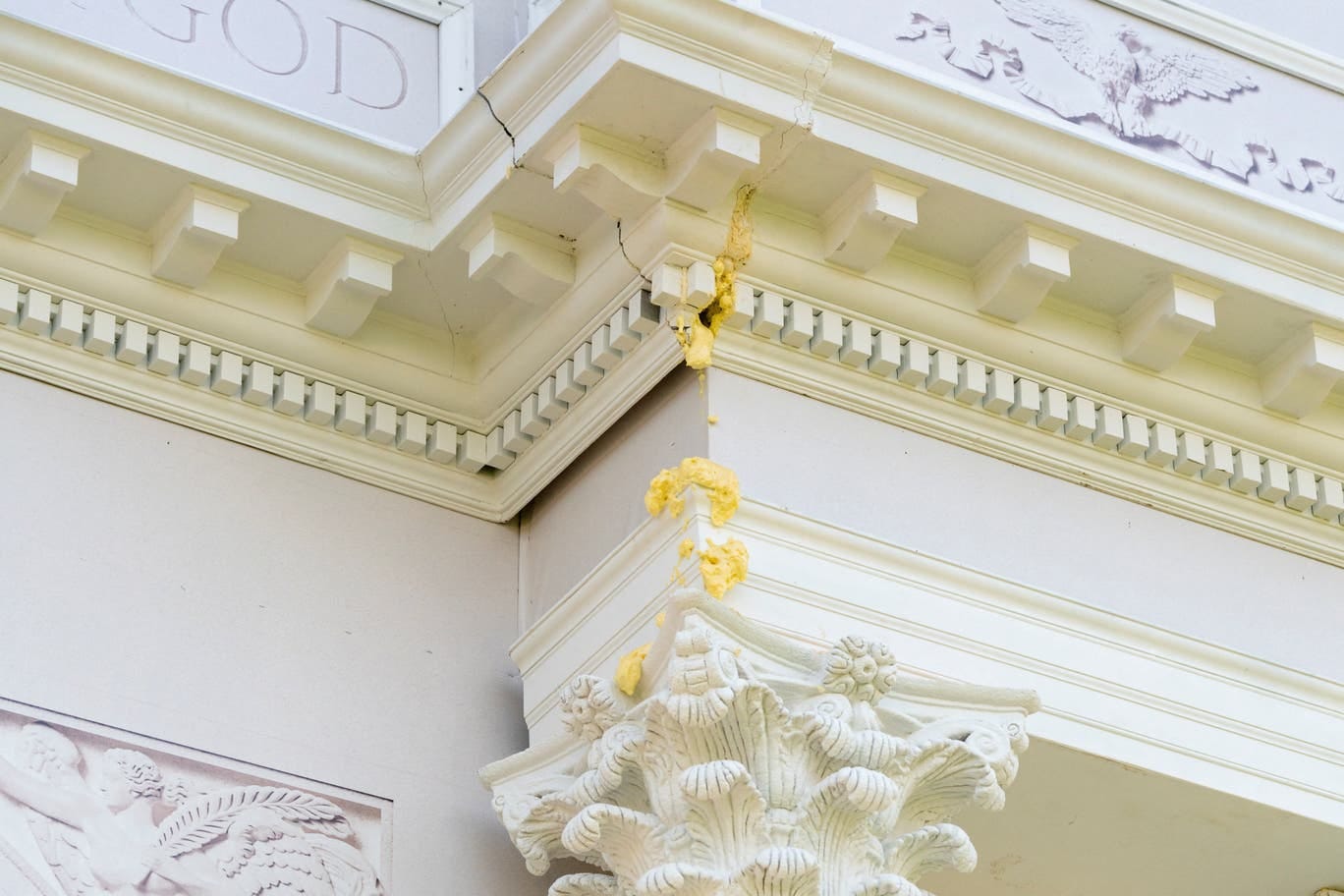
The impression was heightened by details that others have pointed out: decorative architectural elements whose seams revealed expanding polyurethane foam, temporary facades masquerading as permanence, protective coatings peeling from the Reflecting Pool. These details suggested not simply falseness but the deterioration of the illusion itself. The rituals remain, but their animating spirit seems harder to locate. Watching the ceremonies, I found myself wondering whether I was witnessing precisely the phenomenon Huyghe’s monkey embodies: not the disappearance of ritual, but the survival of its choreography after the world that once made those gestures intelligible had begun to fracture.
We inherit institutions, ceremonies, and habits long after the worlds that gave rise to them have changed. Like Huyghe’s monkey, we continue to perform gestures in the hope that repetition alone might restore their significance, as though choreography itself could summon back the spirit that once animated it. The careful preservation of ritual can sometimes reveal not its endurance but its absence.
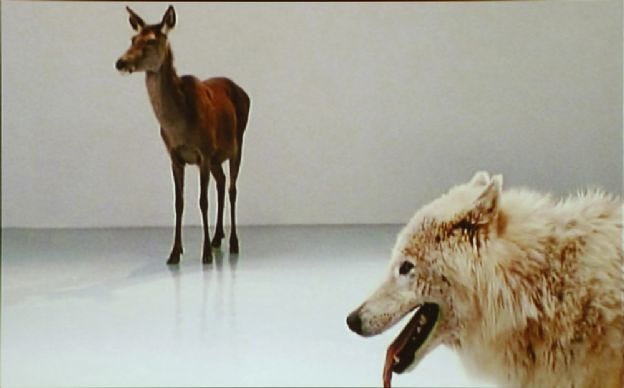
Animals occupy a peculiar place in contemporary art because they allow artists to ask not simply what it means to be human, but what it means to inhabit a world. Taken together, these works suggest that the animal in contemporary art is rarely a symbol of nature. It is a way of asking what kind of world a living being can inhabit. Joseph Beuys’s I Like America and America Likes Me stages an impossible encounter with radical otherness. Mircea Cantor’s Deeparture suspends predator and prey in an uneasy coexistence that resists interpretation. Huyghe’s monkey occupies a more unsettling condition: it is no longer outside human culture but almost entirely enclosed within it, performing habits that are not its own in a world emptied of those who once gave them meaning.
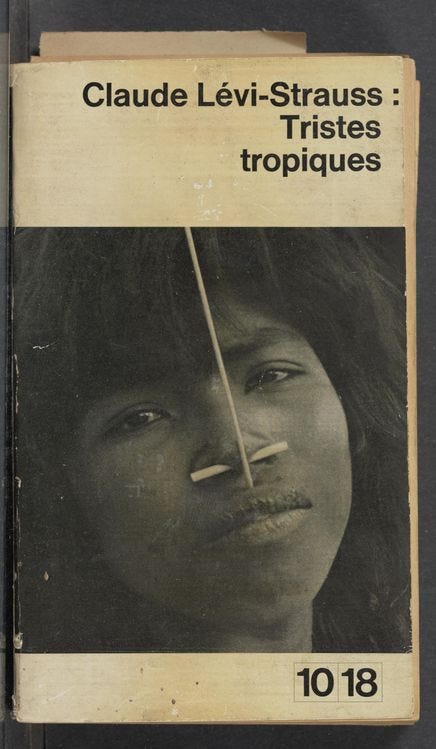
This is perhaps why Human Mask brought to mind Claude Lévi-Strauss’s Tristes Tropiques. Its melancholy is not simply about disappearing forests or endangered peoples but about arriving too late—encountering ways of inhabiting the world that have already begun to dissolve under the pressures of modernity. Huyghe’s monkey is similarly belated. It inhabits the ruins of a social order whose organizing principles have vanished, yet it continues to perform them with unwavering fidelity. Like Lévi-Strauss’s traveler, it has arrived too late to understand the world it still inhabits.
What these works ultimately share is not nostalgia for a lost nature but a concern with orientation. They ask what happens when we continue inhabiting forms after we have forgotten what they were for. If there is hope, it lies not in abandoning ritual nor in restoring an imagined past, but in recovering the capacity to understand the worlds our gestures once presumed and the worlds we hope they might yet create.
At this point I am also reminded of a poem by my uncle, the Mexican poet Eduardo Lizalde, titled Tortuga, written in memory of my cousin’s pet turtle when we were kids. He imagines the animal as a survivor from another geological age, condemned to continue an existence whose origins have long been forgotten. Near the end of the poem he writes:
...grandes huevos estériles,
su único lenguaje,
un simple signo de vida imaginaria,
de mortal consistencia,
de orgánica tarea.
(”...large, sterile eggs, / her only language, / a simple sign of imaginary life, / of mortal substance, / of organic labor.”)
I have often wondered whether these lines are also about us. We continue making things—rituals, institutions, celebrations, works of art—never entirely certain whether they will carry life into the future or merely testify that life once passed through here. Perhaps making is itself a ritual: a gesture addressed to the future, hoping that someone, someday, will answer it.
As several of you know, I write these notes after a difficult few weeks. Our family lost someone we loved. Shortly afterward came the Fourth of July, with its immense machinery of ceremony and spectacle, which, for reasons I have tried to understand in these pages, left me feeling strangely bereft. Yet as I finish writing I have arrived in Chicago for a joyous occasion: my niece’s wedding. Two days later I will be devising another set of happy rituals—small choreographed experiences to celebrate Dannielle’s birthday. The contrast has not been lost on me.
It has reminded me that rituals are not meaningful because they are old, patriotic, religious, or faithfully repeated. They become meaningful because they are inhabited together. Their purpose is not merely to preserve tradition but to strengthen the invisible bonds that allow a community to recognize itself: to express gratitude, to mourn together, to celebrate together, to remind us that our lives acquire significance through one another. Perhaps this is what Huyghe’s monkey ultimately lacks—not freedom, exactly, but a world capable of answering its gestures.
Another reason I find myself resisting too tidy a diagnosis is because, as I write these pages, another immense ritual is unfolding: the FIFA World Cup. By every measure it ought to represent everything Han distrusts about contemporary culture. It is saturated with corporate sponsorship, media spectacle, nationalist sentiment, and commercial interests. Yet when I watch it, none of those things fully account for what I experience.
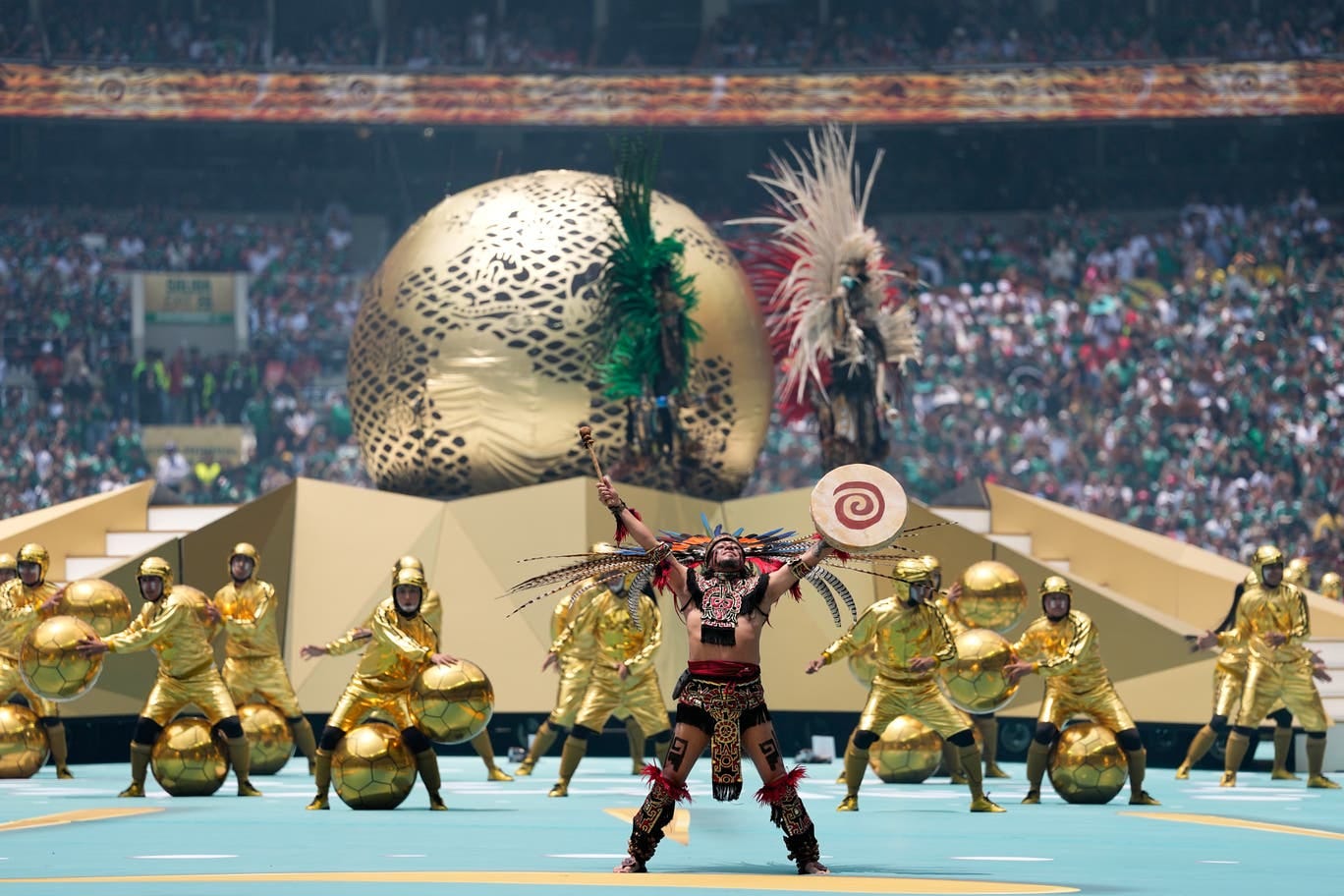
What moves me is not the machinery surrounding it but the astonishing intensity of the collective emotions it still makes possible. For a few weeks, millions of strangers inhabit the same symbolic time. Triumph and heartbreak are shared across families, neighborhoods, cafés, and continents. Friendships are renewed, conversations begin with strangers, entire cities seem to breathe together. Whatever commercial interests sustain the tournament, they do not exhaust its meaning. That ritual really feels real, collective, and heartfelt, as well as deeply meaningful.
Perhaps this is the difference. A ritual does not become meaningful simply because it is old, solemn, or faithfully repeated. Nor does it necessarily become empty because it has been commercialized or politically appropriated. It remains alive insofar as it continues to create a world that people genuinely inhabit together.
We cannot recover vanished worlds, nor should we imagine that they were ever whole. But we can remain attentive to the worlds we are making now. Every ritual, every celebration, every act of mourning asks whether it deepens our relationship to one another or merely repeats a choreography whose meaning has been forgotten. Art cannot restore lost worlds. What it can do is help us rehearse new ones. Every genuine work of art proposes a way of inhabiting the world differently. Sometimes those proposals disappear. Sometimes they become rituals. When they do, they cease to belong to the artist and begin to belong to a community. Perhaps this is why Human Mask is so difficult to leave behind. The monkey continues its gestures because no one has told it the world has changed. We continue ours because we hope, against hope, that our gestures might still summon a world worth inhabiting. Art cannot accomplish that task alone. But it can remind us that meaning is never inherited automatically: it must be made, inhabited together, and answered.
There are images that cannot be simply consumed by the eye; instead, they settle into the body like an uncomfortable vibration. In 2023, within the dim light of a gallery in New York, I found myself transfixed by Pierre Huyghe’s Untitled (Human Mask); I returned to it three times, unable to break the magnetism of its silence. On screen, a macaque monkey wanders through the damp ruins of an abandoned restaurant in Fukushima, trapped in the eternal loop of a human trade that no one is left to demand of it. It wears a Noh theater mask: a white, melancholic porcelain face that freezes all emotion, while beneath that artifice, one can discern the animal’s disoriented gaze and nervous twitching. Today, learning that this very piece continues to mutate and is now being exhibited in Europe, that same sense of urgency returns intact. This creature with an impostor’s face is not just a dystopian fiction; it is the most lucid and devastating mirror of our present. It is the exact metaphor for the invisible threads of power and a silent dehumanization that today, through screens and algorithmic choreographies, pushes newer generations in particular to wear an identical mask: that of performing an automated life within an infrastructure that has forgotten how to be human.