Sustaining Collective Intelligence
Notes on teaching social practice today

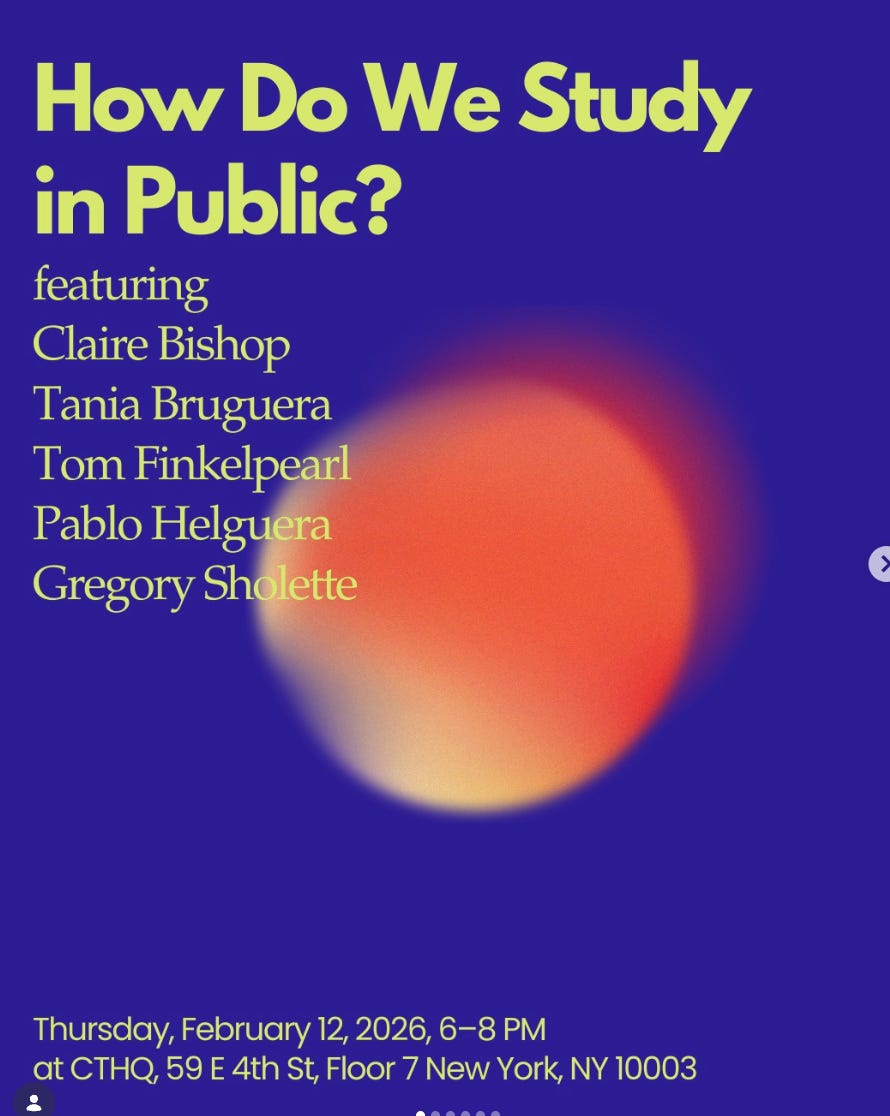
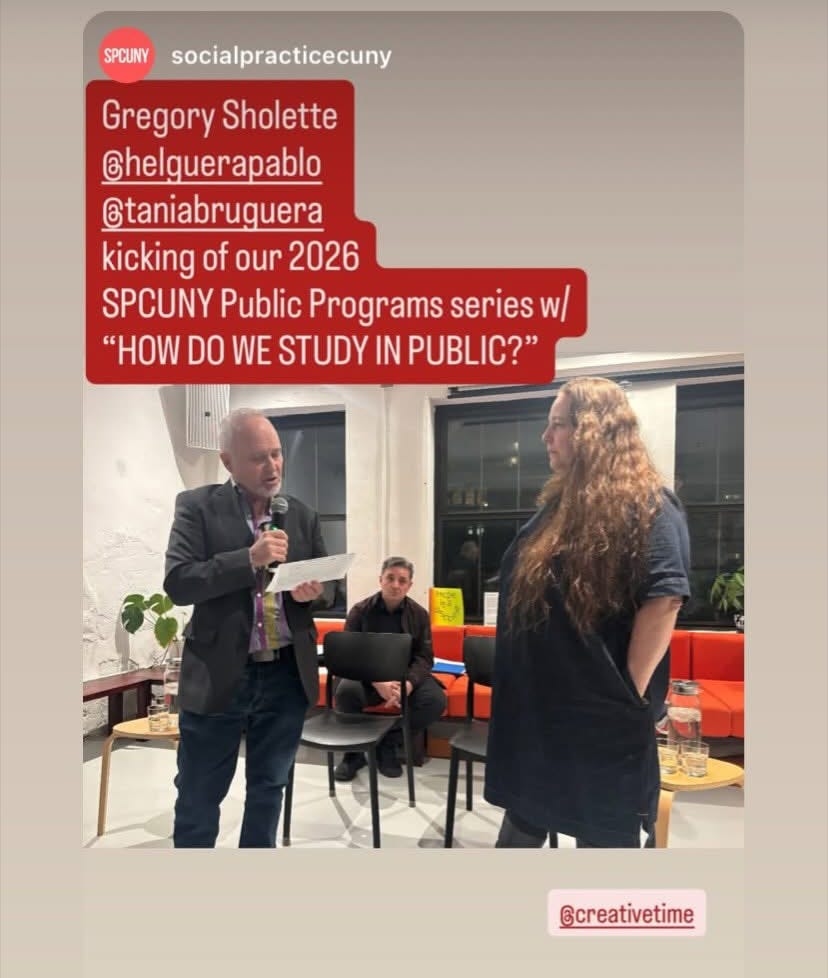
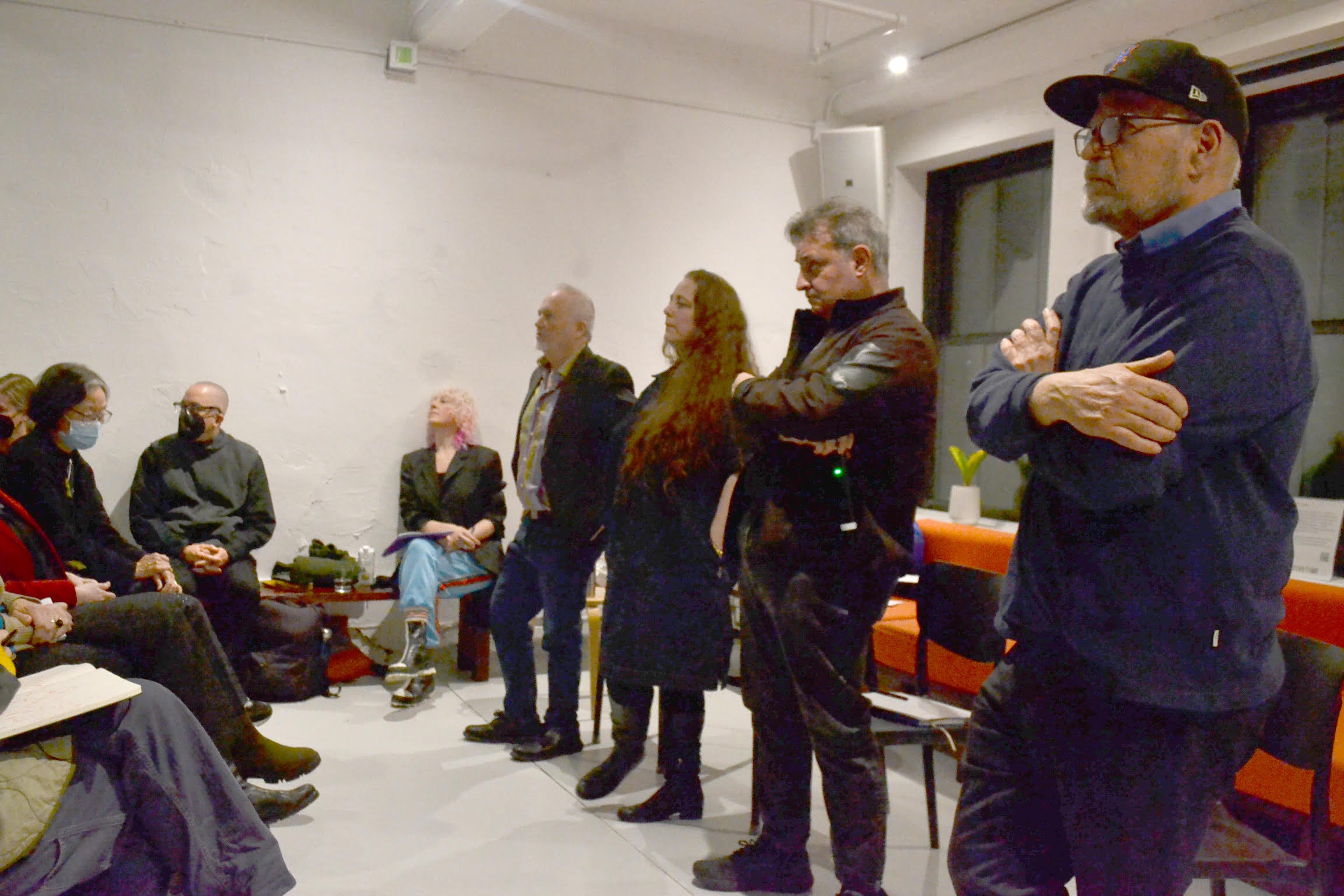
This past Thursday, February 12, I participated in a conversation titled “How Do We Study in Public?” organized by the Social Practice program of the City University of New York (SPCUNY), moderated by Greg Sholette and Tom Finkelpearl, and including Tania Bruguera and Claire Bishop. The event was part of a series examining how socially engaged art functions in different public spheres, beginning with education. The central concern was how the teaching of socially engaged art is faring under the mounting political and economic pressures reshaping the university. The moderators sent out, in advance of the talk, a few preliminary questions for us (a version of which were posed at the event), which I decided to answer in writing. At the end of this text (*) is one of Greg Sholette’s framing questions.
How have you navigated teaching socially engaged art inside institutions you are simultaneously critiquing? What has shifted since the late 1990s—and what is breaking now?
When I began working in museums in the early 1990s, institutions still tolerated critique as a sign of vitality. Today, critique is increasingly framed as reputational or political risk. What is breaking now is the institutional capacity to hold contradiction without converting it immediately into liability.
I have always accepted the contradictory environment in which I work and have tried to act strategically within it. However, I always viewed my primary obligation is to students, just as my earlier obligation in museums was to the public. To serve them, I try to build small ecosystems of support—spaces that allow for critical examination of lived realities in a Freirean sense. If institutions cannot sustain contradiction at scale, classrooms can sometimes sustain it locally.
Have your projects mutated from radical critique into something else—survival programs, holding patterns, or new forms of resistance?
My pedagogical projects emerged during the consolidation of neoliberal higher education, when critique still presumed institutional continuity. What we face now is different. The current push to dismantle universities and cultural institutions is not an aberration; it is a neoliberal goal fully realized.
For that reason, I resist romanticizing collapse. I am interested in salvaging and strengthening the institutions we have collectively built, even as we continue to challenge their failures. Total dismantling often serves the same market logic we claim to oppose.
Some projects today function less as provocations and more as stabilizers or lifeboats. That shift is not a retreat from critique; it is a response to a different historical emergency. We must operate on multiple fronts: continuing to engage institutions in order to influence them, while simultaneously building new networks and models that might endure beyond the present crisis. Authoritarian cycles are not permanent. Our responsibility is to build proactively, not merely reactively.
Are we defending institutions we once attacked? How do we navigate this collision of critiques?
For decades, we critiqued the university from within—its corporatization, debt regimes, and extractive logics. Now we face external assaults through defunding, censorship, and ideological purges. These are not equivalent critiques and should not be conflated.
Defending institutions today does not mean endorsing them uncritically. It means defending the fragile ecosystems within them—students, educators, staff, and forms of inquiry without immediate market value.
Institutions are collections of individuals, some with more agency than others. Many are potential allies. To reduce them all to “the institution” is reductive and counterproductive. Museum education departments, for example, are often disempowered but can be powerful partners when supported.
We must be clear-eyed about what works and what does not, and be willing to design new models that render older ones obsolete—echoing Buckminster Fuller’s insight that change often comes not by fighting the existing model but by creating a better one.
When the ground is collapsing: do we shore up what exists or push harder? What power does experimental pedagogy actually have?
We must think across multiple time horizons simultaneously—short, mid, and long-term; small-scale and structural interventions. This requires ethical clarity and strategic intelligence. Strategy is not a betrayal of values. Purity that renders us incapable of action helps no one.
As an educator, I work locally within the means available to me—classrooms, curricula, small publics—while keeping broader structural realities in view. Experimental pedagogy’s power lies not in scale, but in rehearsal: testing how collective thinking and ethical agency might survive under pressure.
How do you address usefulness and assessment without capitulating to neoliberal metrics?
I resist the notion that artists “solve” social problems. That expectation borrows its logic from philanthropy and policy, not art. The rise of “creative placemaking” exemplifies how social practice can be absorbed into governmental and corporate urban planning agendas.
What socially engaged practice can do is reframe problems, redistribute attention, and build durable relations. It can generate prototypes and models that inform broader change. But cities are not saved by artists any more than they are saved solely by sociologists.
In my teaching, assessment focuses on capacity rather than outcomes: has the student developed a critical lens capable of analyzing complex problems? Can they decide whether their tools belong in art, activism, or a hybrid form?
Usefulness should not be measured by efficiency, but by whether a practice sustains ethical and critical agency over time.
What can we learn from pedagogies developed outside the neoliberal university model?
Pedagogies developed under conditions of scarcity—outside or in resistance to the neoliberal university—operate with heightened awareness of scale, urgency, and interdependence. They are less invested in innovation as branding and more in sustaining collective intelligence necessary for survival.
What travels across contexts is not a method but an ethical orientation: long-duration commitment, improvisation amid instability, and accountability to specific communities rather than abstract performance metrics. What does not travel easily is context. Pedagogies cannot be imported wholesale without distortion or romanticization.
Practices developed outside formal academic or corporate frameworks are often precarious—lacking funding, stability, or recognition—but they are less encumbered by rigid calendars, accreditation systems, and assessment regimes. Their flexibility is not aesthetic; it is infrastructural.
For those of us working within universities—by choice, necessity, or both—the task is not to imitate alternative models, but to remain conscious of our constraints. The question is not how to abolish structure entirely, but how to prevent structure from becoming destiny. A meaningful pedagogical legacy will not lie in training students to navigate imposed metrics efficiently. It will lie in cultivating the autonomy to question them, reinterpret them, and when necessary, refuse them altogether.