
Synthesize This
Compact language and expansive interpretation.

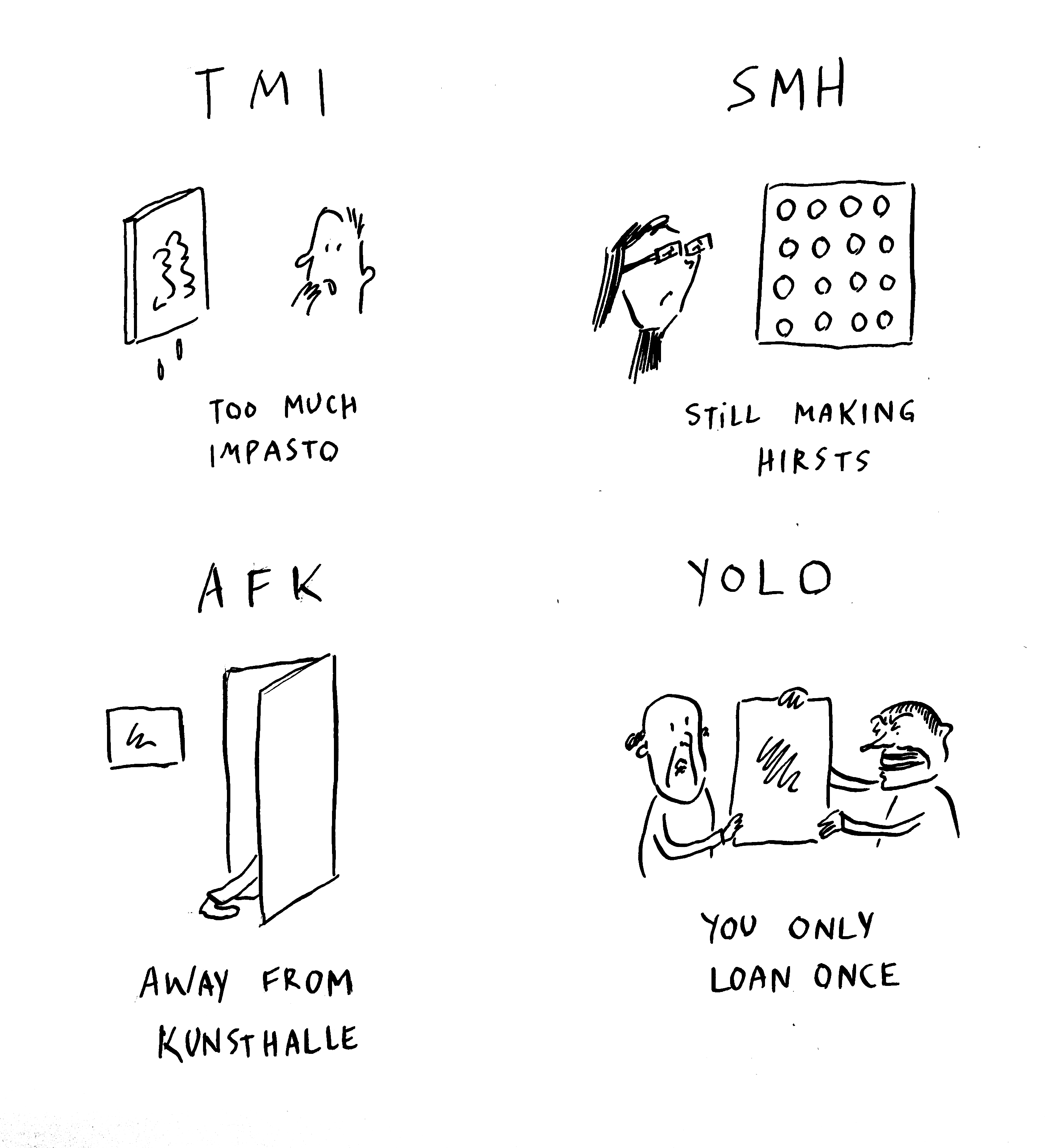
NOTE: This is the 350th dispatch of Beautiful Eccentrics. If you enjoy reading these weekly texts please consider becoming a paid subscriber and help me continue producing this content; or support by purchasing the special anniversary Artoon edition.
As a kid, I was always fond of sopa de letras, often trying to make Scrabble-like words from the letters floating at the edge of the bowl. Looking back, growing up in Mexico sometimes felt like living inside another kind of alphabet soup. Public life—or at least what I could make of it as a child—was saturated with acronyms. Newspapers, government buildings, and television news seemed to speak an almost cryptographic language. Government ministries and agencies (SEP, INBA, INAH, SRE, CONACYT, PEMEX), corporations (FEMSA, CEMEX, TELCEL, CARSO), legal entities (S.A. de C.V.), and universities (UNAM, UAM, UDG) all appeared to exist first as combinations of capital letters and only second as actual institutions.
I often listened to adults discuss politics or current events through this dense shorthand. Entire conversations unfolded as streams of initials that I could barely follow. Long before I understood what these organizations actually did, I had already learned that their acronyms carried authority. To speak fluently in that compressed language suggested expertise, insider knowledge, and belonging. Mastering the alphabet soup felt like a prerequisite for entering public life.

Years later, when I was a latecomer to institutional critique, I found myself returning to this peculiar linguistic habit in my own artistic practice. In the early 2000s, when I began making projects that mimicked the language and appearance of institutions, acronyms became an essential part of their fiction. The Instituto de Investigación de la Telenovela (ININTES) adopted not only the bureaucratic cadence of an official research institute but also the legal suffix “A.C.” (Asociación Civil), the Mexican equivalent of a nonprofit organization. Another, shorter-lived project was IMROT, the International Museum of Radically Ordinary Things, a fictional museum devoted exclusively to collecting objects of complete ordinariness—objects that, paradoxically, would have to be deaccessioned the moment they acquired cultural or monetary value.
Only later did I realize that what fascinated me was not simply the elegance of acronyms but the strange authority they confer. An acronym compresses language while simultaneously expanding prestige. It transforms an unwieldy title into something that feels official, recognizable, and somehow inevitable. Before it communicates meaning, it communicates legitimacy.
In everyday life, compression is everywhere, driven largely by digital communication. Texting has accelerated the invention of abbreviations, acronyms, emojis, GIFs, and other shorthand forms that increasingly blur the distinction between writing and image. As linguist Cherry Meyer observes, “Texting gives us a visual representation of linguistic information.” This raises an intriguing possibility: after nearly three thousand years of alphabetic writing, language may once again be acquiring an iconic dimension. While we are hardly returning to Egyptian hieroglyphs or Chinese characters, contemporary communication increasingly depends on signs that function as much visually as phonetically.
Compression does more than save time; it creates communities. Acronyms, abbreviations, and texting shorthand function as social passwords. Their meaning is immediately apparent to those “in the know” while remaining opaque to everyone else. In that sense, they resemble the bureaucratic acronyms of my childhood in Mexico. To speak them fluently is to signal membership in a particular institution, profession, or generation.
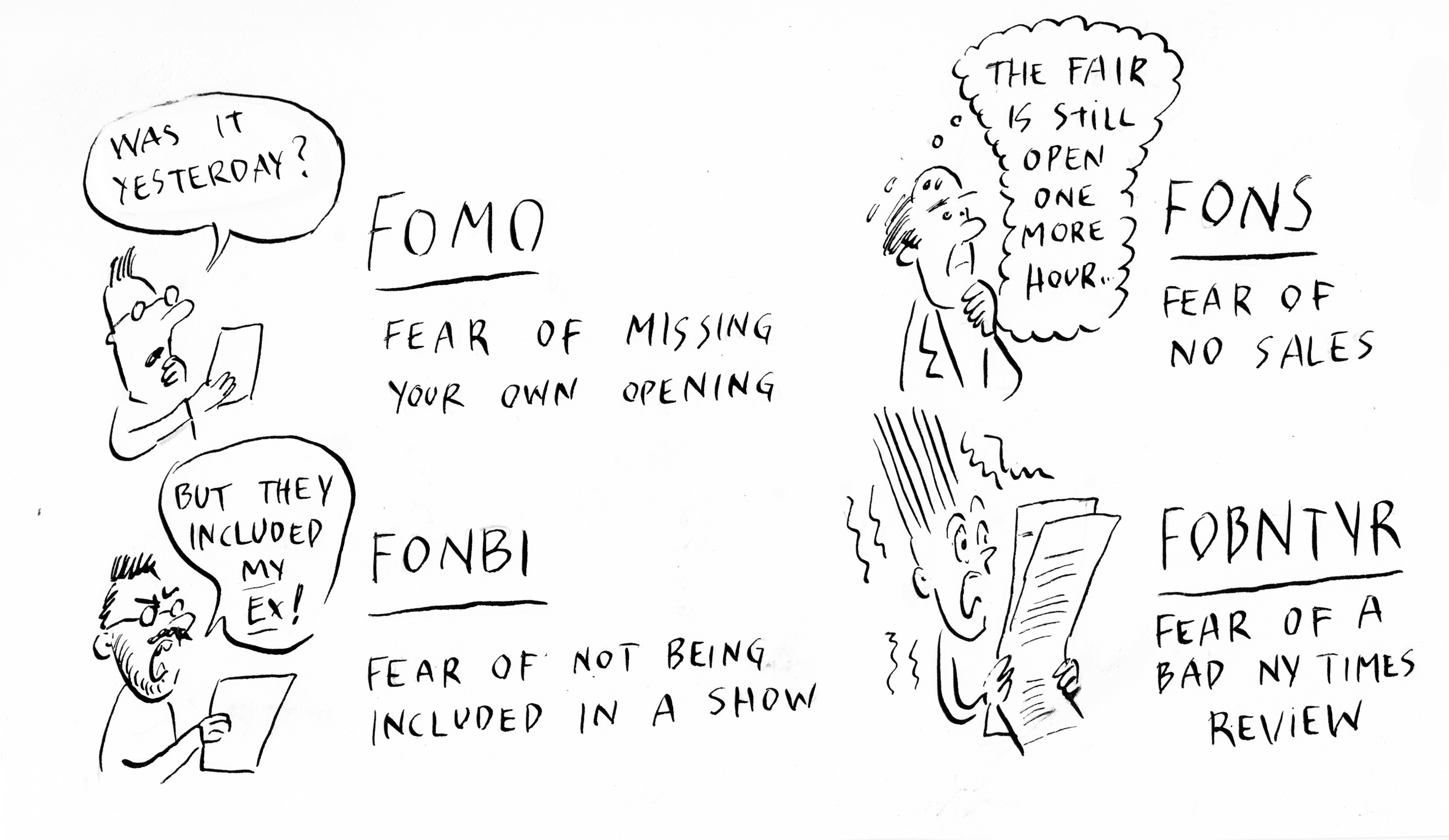
I have become fascinated by this phenomenon through my Gen Z teenage daughter. Every so often I will notice her typing a new abbreviation that has become part of her and her friends’ texting vocabulary. Some are standard, like TBH (”to be honest”) or IDK (”I don’t know”). Others—lowkey (or lowk), atp (”at this point”), or bffr (”be for real”)—often require translation. Increasingly, words are replaced altogether by emojis or combinations of symbols. (”UwU is a bit cringey,” she recently informed me, referring not to a word but to an emoticon that has acquired an entire cultural history.) Like all slang, these expressions function as generational markers, instantly recognizable to those who belong and largely opaque to those who do not.
None of this is entirely new. My classmates in Mexico City during the 1980s also had expressions that mystified adults and cemented our own sense of belonging. Every generation invents its own shorthand. What feels different today is the degree of compression made possible by digital communication. The smartphone has become an engine for condensing language into ever smaller units—initials, emojis, punctuation, and symbols—that can convey entire moods, situations, or social cues in just a handful of characters.

In Mexico during the 1960s, the writers of La Onda—José Agustín, Gustavo Sainz, Parménides García Saldaña, and others—rebelled against the literary conventions of the previous generation by importing into fiction the slang, rhythms, pop culture, and psychedelia of urban youth. Their language was deliberately colloquial, ephemeral, and coded, standing in sharp contrast to the cultivated, cosmopolitan prose associated with writers such as Octavio Paz. What they brought into literature was not simply a new vocabulary but a new theory of what literary language could be.
Then, as now, the question was not merely stylistic but philosophical. Is linguistic abundance inherently superior to linguistic economy? We tend to associate education with an expansive vocabulary, as though intellectual sophistication were measured by the sheer number of words one commands. Great literature—from Cervantes to Shakespeare to George Eliot to Joyce to Clarice Lispector—certainly seems to support that intuition. Yet everyday communication often suggests the opposite. A small repertoire of words, deployed with precision and shared cultural understanding, can sometimes communicate more effectively than an encyclopedic lexicon.
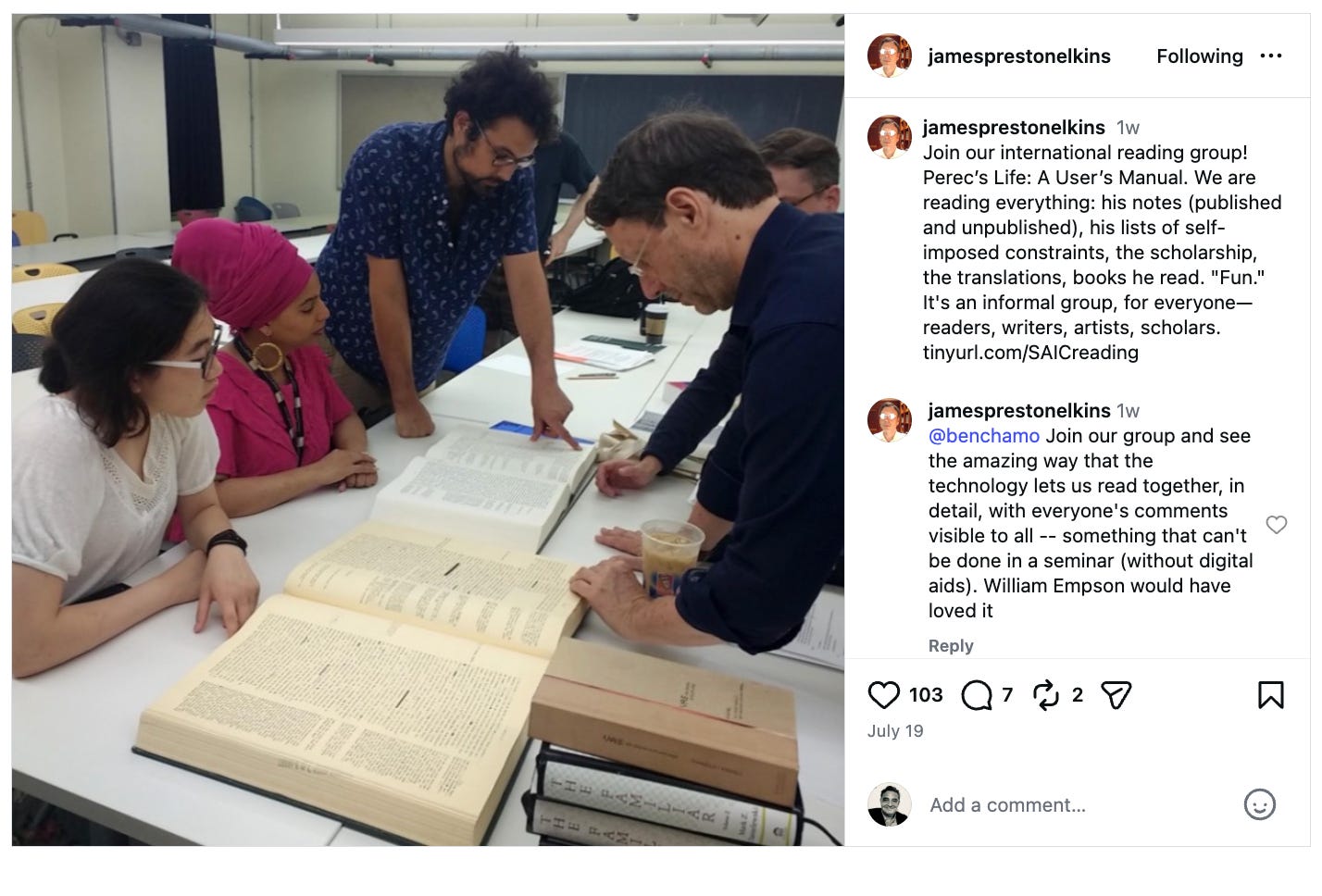
I am often in touch with, and follow the doings of James Elkins, the influential Chicago art historian who in recent years has devoted himself increasingly to fiction (he is now amidst publishing a major experimental novel project of his own consisting of five books; I wrote about his first volume three years ago, and the third volume comes out in October). He has an informal reading group he organized to tackle what may be one of the most daunting literary works ever written: Arno Schmidt’s Bottom’s Dream. Elkins describes it as “a book harder, longer and less read than Finnegans Wake.” The volume itself is roughly 13 by 18 inches, weighing nearly eighteen pounds and spanning some 1,300 pages. His group has been meeting for five years and has only reached the halfway point.
I find something very meaningful about that level of commitment. It resembles less an ordinary book club than a monastic practice, an act of collective devotion to a single work. If I were Arno Schmidt, I could imagine no greater tribute than knowing a handful of readers had willingly devoted years of their lives to inhabiting my book. Yet it also raises an intriguing question. What happens to a work whose richness makes it accessible only to the most dedicated readers? Does literary ambition eventually reach a point where it withdraws from the public sphere altogether?
When I later asked Elkins what five years of reading Bottom’s Dream had taught him, his answer surprised me. The group’s greatest discovery was not mastery but forgetfulness. They even invented a symbol—”< ! >”—to mark those recurring moments when everyone knew they had discussed something extensively but could no longer remember when or what had been said. As Elkins put it, “a rich reading is a slow reading, but it is also a reading ruined in part by amnesia.” The richer the text became, the less recoverable it seemed in memory. Yet he insists the experience has made reading itself “more complex, more engaging and immersive” than any academic seminar he has known. Perhaps literary abundance has its own paradox: beyond a certain threshold, understanding no longer depends on retaining everything but on willingly inhabiting a landscape too vast to possess.
Schmidt may be the quintessential “writer’s writer”: an author whose innovations are less likely to shape a mass readership than to influence generations of other writers. At the opposite extreme are today’s compressed dialects of texting, in which entire emotional worlds are condensed into a handful of letters or an emoji. One asks extraordinary patience of its readers; the other assumes almost instantaneous recognition. They appear to occupy opposite poles of language, yet both rely on communities of insiders. Bottom’s Dream demands years of apprenticeship. “BFFR” demands membership in a generation. Neither speaks equally to everyone.

If Arno Schmidt represents one extreme of literary abundance, Aram Saroyan occupies the opposite pole. Best known for his one-word poems, Saroyan sought to reduce language to its smallest meaningful unit without sacrificing its imaginative potential. His most celebrated work, lighght (1965), consists of a single altered word—”light” expanded by one additional “gh.” First published as a poster by Brice Marden in 1966, the poem became one of the defining gestures of minimalist literature. With a single typographic intervention, Saroyan transformed an ordinary word into an object of prolonged attention, making readers hesitate between reading, seeing, and deciphering.
The contrast between Schmidt and Saroyan could hardly be greater. One constructs a literary universe so vast that reading it becomes a years-long commitment; the other asks whether a poem can exist in a single word—or perhaps a single extra letter. Yet both works are animated by the same ambition: to push language to its limits. One does so through accumulation, the other through reduction.
Perhaps the real opposition is not between a large vocabulary and a small one, but between breadth and density. A rich language offers many possible distinctions; a compressed language asks each sign to carry a disproportionate amount of meaning. The question is not how many words we possess, but how much meaning each word—or acronym, emoji, or abbreviation—is capable of bearing.
Nobel prize physicist Richard Feynman famously distrusted unnecessary complexity. He often suggested that when we cannot explain something simply, it is because we do not yet understand it well enough. Complexity, in that sense, becomes a disguise for ignorance. I find that idea deeply persuasive. Yet the opposite danger also exists. Simplicity can become its own disguise. A slogan can conceal ambiguity. An acronym can compress an institution. A minimalist artwork can require years of interpretation. Brevity is no guarantee of transparency.
Novels have traditionally been literature’s vehicle for complexity. They unfold worlds over hundreds or thousands of pages, accumulating characters, plots, digressions, and voices. Poetry, by contrast, has often pursued synthesis rather than expansion. Yet something curious happens at the highest levels of each. Despite the monumental scale of Ulysses or Finnegans Wake, what ultimately enters literary history are not their thousands of pages but a handful of governing ideas: the interior monologue, the reinvention of language, the collapse of narrative convention. Their influence depends less on the number of pages than on the concepts they release into culture.
Kenny Goldsmith has drawn a distinction between readership and thinkership (arguing that as artist he seeks the latter). The greatest experimental works often produce relatively few readers but an extraordinary number of thinkers. Their innovations circulate far beyond those who have actually completed them.
At that point, Arno Schmidt’s Bottom’s Dream and Aram Saroyan’s lighght begin to resemble one another. One expands language almost beyond endurance; the other compresses it almost to disappearance. Yet both ultimately produce the same thing: an interpretive space that is effectively limitless. The measure of a work is not the number of words it contains, but the number of thoughts it continues to produce.
Which brings me back to where I began: the Mexican fascination with acronyms. If I wanted to summarize everything I have argued here in the form of a hybrid between a cross-generational Gen Z text and my Gen-X Mexican governmental institutional acronym, I might suggest:
LEWIB
Language Ends Where Interpretation Begins.
Or better:
Lovely meditation, Pablo, thank you. Compression and expansion are a fascinating way to think abour our reading project too. There are pinpoints of compression in Schmidt's book, where single words or parts of words conjure the entire life work of different authors. They're like tiny black holes. (As I understand it, black holes as small as a proton or neutron might exist; they would weigh as much as a mountain.)
If we were to stop to read the many volumes written by the authors Schmidt cites, it would be like extracting the compressed information from those tiny black holes. We don't, usually. We steer around them: we go just close enough to feel the pull, and then we move away, because we prefer our expansive, possibly endless, undoubtedly amnesiac reading to be pulled by the lure of compression, but we don't want to be trapped inside those pinprick citations.
Fascinating, and so nicely said